Ghee for Pooja: Which Ghee Is Best for Diya & Religious Rituals?
Walk into any Hindu household during festival season and you will find a diya burning with ghee. This is not merely custom — Vedic scriptures specify cow ghee as a mandatory offering material, distinguishing it explicitly from vegetable oils or adulterated fats. But why does it matter which ghee you use? And with so many products labelled “ghee” on the market, how do you ensure your ritual offering meets the standards the tradition intends? This article explores the religious, sensory, and qualitative reasons that pure A2 desi cow ghee remains the only appropriate choice for puja and ritual use.
What the Vedic Tradition Mandates
The Sanskrit term Go-ghrita — ghee from the cow — appears throughout the Vedas, Upanishads, and Puranas as an essential offering in yajna (fire sacrifice), diya lighting, and daily puja. The Rigveda refers to ghee as the “navel of immortality” (ghruta), and the Charaka Samhita describes cow ghee as the most sattvic of all foods — conducive to mental clarity, purity, and spiritual awareness.
Critically, the tradition does not simply specify any cow — it specifies the native cow, or desi gau. The distinction matters because ancient texts describe the Panchagavya (five cow products) as possessing purifying properties that are understood to derive from the native Indian breeds specifically. Buffalo ghee, vanaspati, and certainly hydrogenated vegetable oil have never been considered acceptable substitutes in orthodox Vedic practice.
The sattvic quality attributed to pure desi cow ghee — a quality said to promote clarity, calm, and spiritual receptivity — stands in contrast to rajasic (stimulating) and tamasic (dulling) food categories. In Ayurvedic and Vedic cosmology, the food and substances used in ritual carry energetic properties that affect the atmosphere of worship and the mental state of the devotee.
A2 Ghee vs Regular Ghee for Puja: Why the Difference Matters
Most regular market ghee sold in India today — including many well-known brand names — is produced from the milk of Holstein-Friesian crossbred cows that produce A1 beta-casein milk. Traditional Vedic texts and Ayurvedic authorities consistently specify the native cow (desi gau) — breeds like Gir, Sahiwal, Kangayam, Tharparkar, and Umbalachery — all of which naturally produce only A2 beta-casein milk.
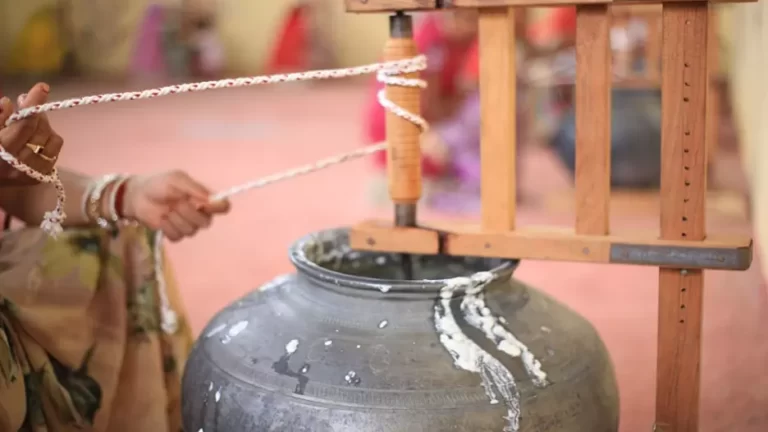
Beyond the protein difference, the production method matters for ritual use. Bilona-method ghee — made by first culturing the milk into curd, hand-churning the curd to extract butter, and then clarifying the butter over a slow flame — is the process described in ancient texts. The Vishnu Purana mentions the churning of milk as a cosmic act of creation (samudra manthan), and the method of hand-churning curd is seen as preserving the life-force or prana of the milk.
In contrast, modern large-scale ghee is made by centrifuge-separating cream from milk and then clarifying it — a process that is efficient but bears no resemblance to the traditional bilona method. The resulting product may be chemically similar in terms of fat content, but it lacks the context of traditional preparation that Vedic ritual intends.
The Flame: Sensory and Atmospheric Significance
Those who regularly light diyas with pure A2 bilona ghee versus regular market ghee describe a noticeable difference in the flame quality. Pure ghee produces a steady, bright, clean-burning flame with minimal smoke. Adulterated ghee or ghee with residual moisture produces flickering, smoky flames with an acrid smell.
This is not merely aesthetic. In Vedic ritual, the smoke of the ghee flame (dhupa) is understood to carry the offering upward. The quality of combustion — the completeness of burning, the aroma, the steadiness of the flame — is considered a reflection of the purity of the offering material. A clean-burning flame is also practically preferable: it does not blacken the lamp or idols and does not irritate eyes and respiratory passages during extended puja.
The reason pure ghee burns cleanly is its low water content (typically under 0.1% moisture in well-made bilona ghee) and high smoke point. Impure or diluted ghee that contains vegetable oils, added water, or residual milk solids burns less completely.
Ghee in Festivals: Pongal, Diwali, Navratri, and More
Across South and North India, ghee is central to the ritual calendar:
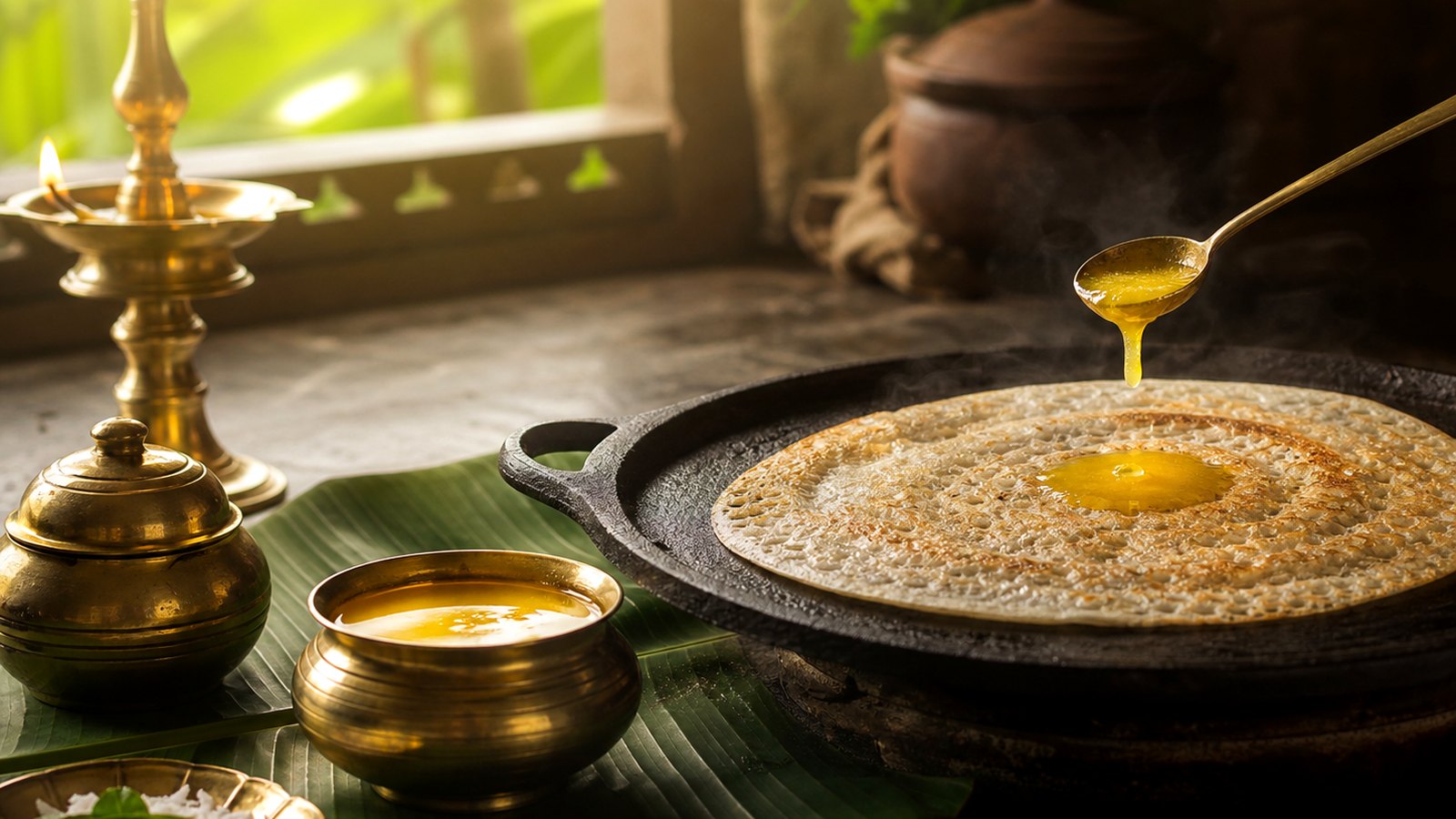
- Pongal: The freshly harvested rice is cooked with jaggery and ghee as a gratitude offering. The Pongal pot overflowing is considered auspicious, and the ghee is not merely flavouring — it is an integral part of the offering to Surya (the Sun) and to the community gathered.
- Diwali: Thousands of diyas are lit with ghee across homes, temples, and public spaces. Pure ghee diyas during Diwali are associated with Lakshmi’s presence; many families who have shifted to oil diyas for cost reasons return to ghee diyas for at least the central lamps on the main night of celebration.
- Navratri: The nine-night worship of Devi involves akhand jyoti (unbroken flame) that must be maintained for the full duration. A stable, unbroken flame for nine days requires very pure ghee — adulterated ghee causes the flame to sputter or extinguish.
- Satyanarayan Katha and homams: These rituals involve direct oblations of ghee into fire. The quantity of ghee used is significant, and authenticity is explicitly required by the ritual protocols.
Choosing Ghee for Ritual Use
For puja and diya use, the following criteria should guide your selection:
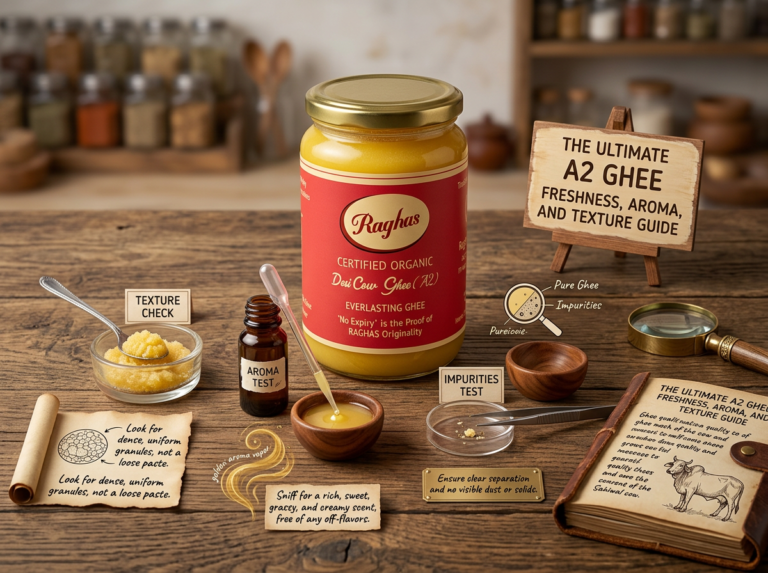
- Made from desi cow milk — preferably native breeds, not crossbreds
- Bilona method preferred over cream-separator method
- No added colour, flavour, or preservatives
- Golden-yellow colour (from beta-carotene in the milk), grainy crystalline texture at room temperature
- FSSAI licensed and traceable to source
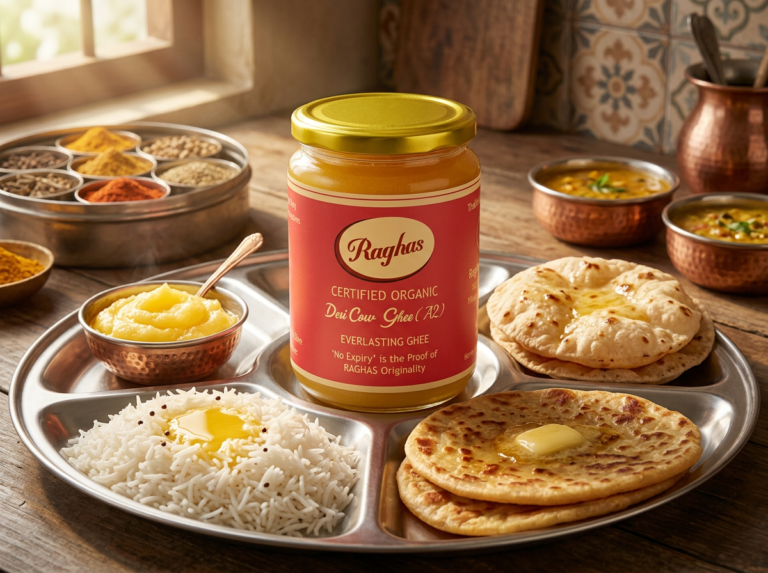
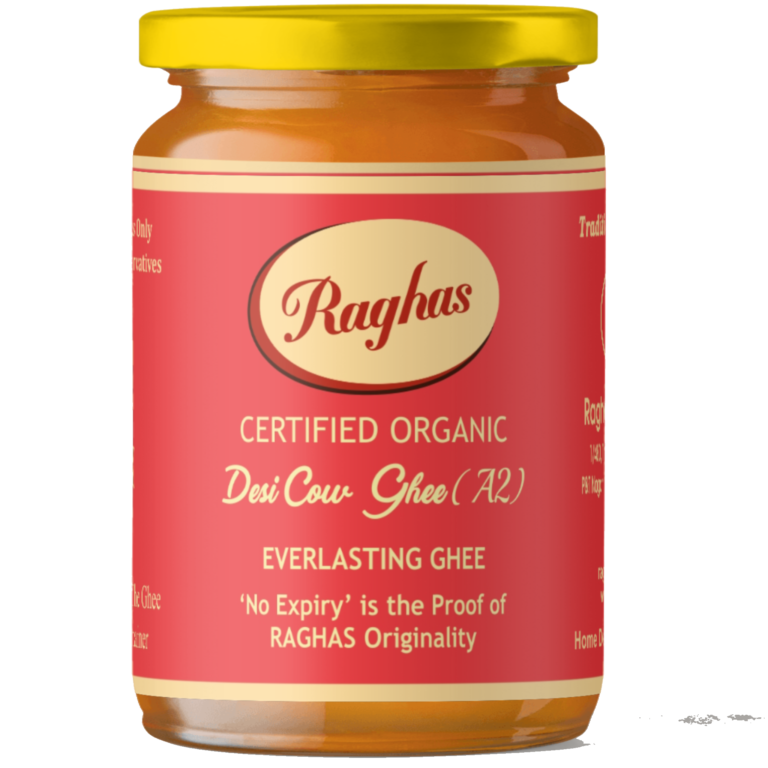
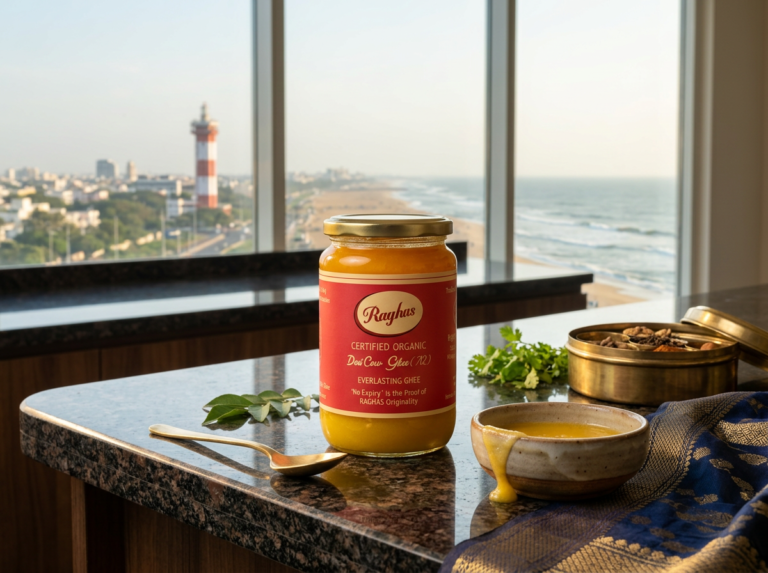
Raghas Dairy’s A2 ghee, made from Tamil Nadu native desi cows using the traditional bilona method, meets all these criteria. It is FSSAI licensed (12416012000957) and produced without shortcuts or additives. For your next puja, festival, or akhand jyoti, you can explore it at raghasdairy.com/shop.