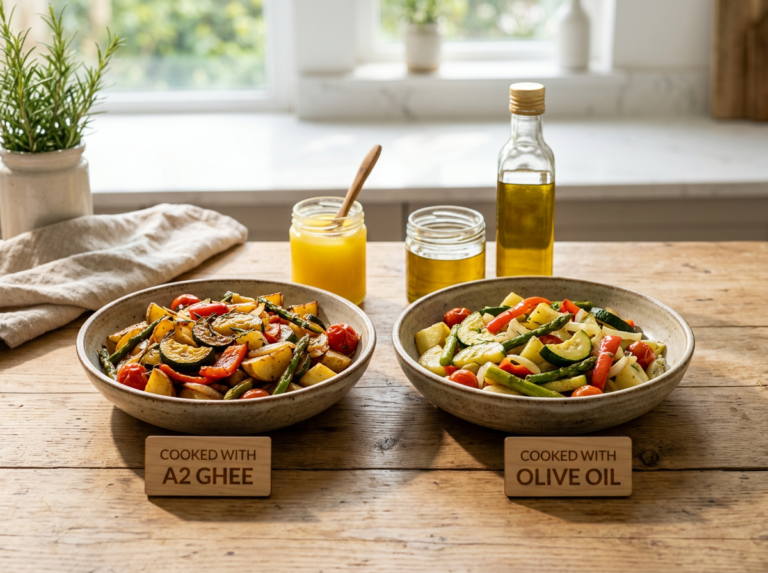
A2 Ghee for Weight Gain & Muscle Building
A2 Ghee for Weight Gain & Muscle Building
A2 ghee for weight gain is one of the most effective and natural strategies available. At approximately 120 calories per tablespoon, A2 desi cow ghee is one of the most calorie-dense whole foods you can eat. Whether you’re an underweight adult, a parent trying to help a thin child, or a bodybuilder in a bulking phase, A2 ghee provides clean, nutrient-rich calories that support healthy weight gain — not just fat accumulation.
This guide covers how A2 ghee helps you gain weight, how much to eat, meal ideas, specific advice for kids and bodybuilders, and how to gain weight without compromising health.
- Why A2 Ghee Is Ideal for Weight Gain
- A2 Ghee Nutrition: The Numbers
- How Much A2 Ghee Per Day for Weight Gain
- Meal Ideas: Adding A2 Ghee for Extra Calories
- A2 Ghee for Underweight Kids
- A2 Ghee for Muscle Building & Bodybuilding
- Weight Recovery After Illness
- Healthy Weight Gain vs Unhealthy Weight Gain
- Frequently Asked Questions
- Key Takeaways
Why A2 Ghee Is Ideal for Weight Gain
Not all calorie sources are equal. Here’s why A2 ghee stands out for healthy weight gain:
- Calorie-dense — 900 calories per 100g (120 cal per tablespoon). Small amounts add significant calories without needing to eat large volumes
- Nutrient-rich calories — Unlike junk food, A2 ghee delivers vitamins A, D, E, K2, CLA, and butyric acid alongside calories
- Improves nutrient absorption — Fat-soluble vitamins and minerals from other foods absorb better with ghee
- Easy to add to any meal — Mix with rice, dal, roti, porridge, milk — it enhances flavour and adds calories without changing the dish
- Supports gut health — Butyric acid ensures your gut absorbs nutrients efficiently, crucial for weight gain
- No additives or sugar — Clean calories unlike weight gain supplements or processed foods
At Raghas Dairy, our ghee is made from milk sourced from a mixed Tamil Nadu native desi cow herd. This gives you ghee with the highest nutritional density.
A2 ghee — a natural way to gain healthy weight
A2 Ghee Nutrition: The Numbers
Here’s what you get from A2 ghee (full nutrition facts):
| Nutrient | Per Tablespoon (14g) | Per 100g |
|---|---|---|
| Calories | ~120 kcal | ~900 kcal |
| Total Fat | 14g | 99.7g |
| Saturated Fat | 9g | 62g |
| Monounsaturated Fat | 4g | 29g |
| Butyric Acid | ~0.5g | ~3.5g |
| CLA | ~0.1g | ~0.8g |
| Vitamin A | ~8% DV | ~60% DV |
| Vitamin D | ~2% DV | ~15% DV |
Key insight: Just 3 tablespoons of A2 ghee adds 360 calories to your daily intake. Over a week, that’s 2,520 extra calories — enough for about 0.3 kg of healthy weight gain.
How Much A2 Ghee Per Day for Weight Gain
Your ideal daily ghee intake depends on your goal:
| Goal | A2 Ghee Per Day | Extra Calories |
|---|---|---|
| Gradual weight gain | 2 tablespoons | ~240 kcal |
| Active weight gain | 3-4 tablespoons | ~360-480 kcal |
| Bodybuilding bulk | 3-5 tablespoons | ~360-600 kcal |
| Children (underweight) | 2-4 teaspoons | ~80-160 kcal |
| Post-illness recovery | 2-3 tablespoons | ~240-360 kcal |
Spread across meals — Don’t consume all ghee at once. Divide it between breakfast, lunch, dinner, and snacks for better absorption and easier digestion.
Meal Ideas: Adding A2 Ghee for Extra Calories
Breakfast
- Ghee roti/paratha — Apply 1 tablespoon ghee on hot chapati or make ghee parathas (+120 cal)
- Oats/porridge with ghee — Stir 1 tablespoon into hot oats with nuts and jaggery (+120 cal)
- Ghee banana shake — Blend banana, milk, 1 tsp ghee, dates (+350 cal total)
- Dosa/idli with ghee — Pour ghee on hot dosa instead of oil (+120 cal)
Lunch & Dinner
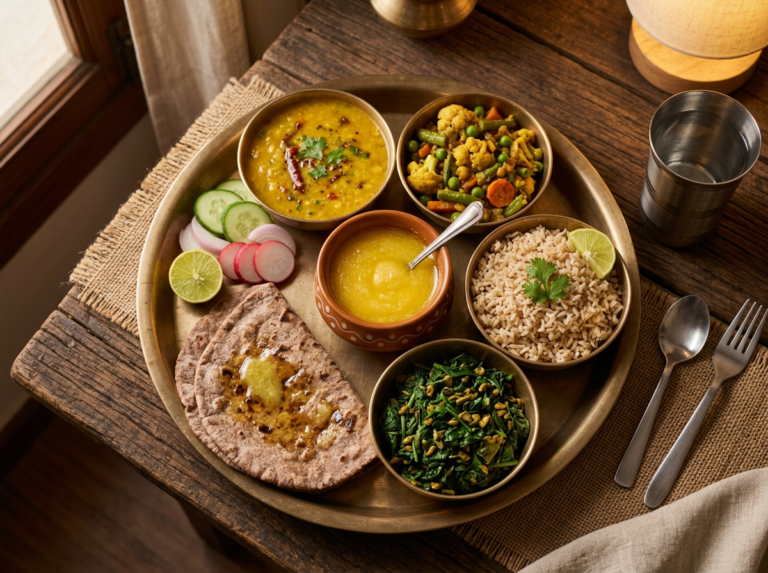
- Ghee rice — Mix 1-2 tablespoons into hot rice with dal (+120-240 cal)
- Ghee tadka dal — Use generous ghee for tempering (+120 cal)
- Sambar/curry with ghee drizzle — Add after cooking to preserve flavour and nutrients
- Ghee on chapati — Classic. Every roti gets a teaspoon (+40 cal per roti)
Snacks
- Ghee laddu — Traditional energy balls with ghee, dry fruits, nuts
- Ghee roasted nuts — Almonds, cashews roasted in ghee
- Banana + ghee — A simple Ayurvedic weight-gain combo
- Ghee coffee/bulletproof coffee — 1 tsp ghee blended into morning coffee
A2 Ghee for Underweight Kids
A2 ghee is particularly valuable for underweight children because:
- Calorie-dense without bulk — Kids with small appetites can get extra calories without needing to eat more food
- Brain development — 60% of the brain is fat. Ghee provides essential fatty acids for growing brains
- Vitamin A for growth — Critical for cellular growth and immune development
- Easy to sneak into food — Kids won’t notice ghee mixed into rice, dal, or porridge
Age-wise guide:
- 6-12 months: ½ teaspoon mixed into mashed food (after introducing solids)
- 1-3 years: 1-2 teaspoons daily in food
- 3-8 years: 2-3 teaspoons daily
- 8-14 years: 1-2 tablespoons daily
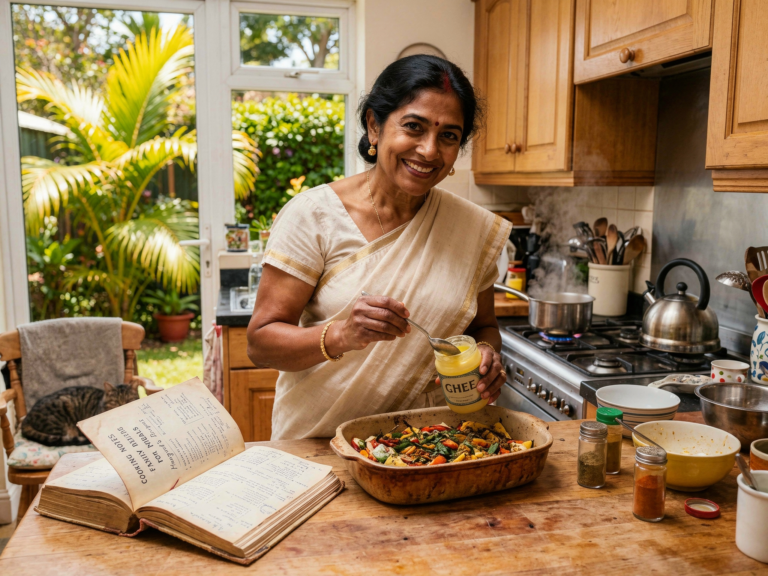
Traditional Indian grandmothers have been adding ghee to children’s meals for centuries — modern nutrition confirms this wisdom. The fat-soluble vitamins in A2 ghee are essential for growth spurts.
A2 Ghee for Muscle Building & Bodybuilding
For muscle building, you need a caloric surplus plus adequate protein. A2 ghee fits perfectly into a bulking diet:
Why bodybuilders should use A2 ghee:
- Caloric surplus made easy — 3 tablespoons = 360 extra calories without feeling stuffed
- CLA for lean mass — Studies suggest CLA may help partition calories toward lean tissue rather than fat
- Fat-soluble vitamin delivery — Vitamins A and D support testosterone production and muscle recovery
- Sustained energy — Fat provides long-lasting energy for intense training sessions
- Better nutrient absorption — Protein and micronutrients from meals absorb better with dietary fat
Bodybuilding meal plan with A2 ghee:
- Pre-workout (2h before): Rice + dal + 1 tbsp ghee — sustained energy
- Post-workout: Ghee rice with eggs/paneer — calories for recovery
- Before bed: Warm milk + 1 tsp ghee + turmeric — anti-inflammatory recovery
Also see our guide on A2 ghee for weight loss — yes, the same food can help with both goals depending on dosage and overall diet.
Weight Recovery After Illness
After illness, surgery, or prolonged infection, A2 ghee helps recovery because:
- Gentle on the digestive system (unlike heavy foods)
- Provides concentrated calories when appetite is low
- Butyric acid helps heal the gut lining (often damaged during illness)
- Fat-soluble vitamins support immune recovery
Recovery protocol: Start with 1 teaspoon of ghee in khichdi or rice kanji. Increase by ½ teaspoon daily as appetite returns. Within a week, aim for 2-3 tablespoons daily.
Healthy Weight Gain vs Unhealthy Weight Gain
There’s a crucial difference between gaining healthy weight and just accumulating fat:
| Healthy Weight Gain | Unhealthy Weight Gain |
|---|---|
| A2 ghee + whole foods | Junk food + sugary drinks |
| Gradual (0.25-0.5 kg/week) | Rapid (mostly fat) |
| Combined with exercise | Sedentary |
| Muscle + healthy fat | Visceral fat around organs |
| Nutrient-dense calories | Empty calories |
A2 ghee supports healthy weight gain because it provides calories alongside vitamins, CLA, and butyric acid — nourishing your body while adding mass.
Frequently Asked Questions
Does A2 ghee help in weight gain?
Yes. At 120 calories per tablespoon, A2 ghee is an efficient calorie source. Adding 2-3 tablespoons daily adds 240-360 extra calories, promoting healthy weight gain when combined with balanced meals.
How much ghee per day for weight gain?
2-4 tablespoons daily for adults, spread across meals. For children, 2-4 teaspoons daily. Combine with protein-rich foods and exercise for lean mass gain.
Is A2 ghee good for muscle building?
Yes. It provides the caloric surplus needed for muscle growth, CLA for lean mass, fat-soluble vitamins for recovery, and improved nutrient absorption. Pair with adequate protein and strength training.
Can I give A2 ghee to my underweight child?
Absolutely. A2 ghee is excellent for underweight children — calorie-dense, easy to mix into food, and provides brain-developing fatty acids and vitamins. 1-2 teaspoons daily from age 1+.
Key Takeaways
- A2 ghee provides 120 calories per tablespoon — one of the most calorie-dense natural foods
- 2-4 tablespoons daily for adults seeking healthy weight gain
- Provides nutrient-rich calories — vitamins A, D, K2, CLA, and butyric acid
- Excellent for underweight children — easy to add to any meal
- Supports muscle building when combined with protein and resistance training
- Focus on healthy weight gain — combine ghee with whole foods, not junk food
Gain Healthy Weight with Raghas A2 Ghee
Nutrient-dense, Bilona-method ghee made from milk sourced from Tamil Nadu native desi cows. Pure calories with real nutrition.
Free shipping on orders above ₹1,750.
Written by the Raghas Dairy Team from Madurai, Tamil Nadu. We make A2 ghee from milk sourced from Tamil Nadu native desi cows using the traditional Bilona method — hand-churned from curd, slow-cooked over wood fire.
Frequently Asked Questions
What makes A2 desi ghee different from regular ghee?
A2 desi ghee is made from milk of indigenous cows that produce A2 beta-casein protein, which is easier to digest and more beneficial for health compared to A1 protein found in regular ghee.
How should I store desi ghee?
Store desi ghee in a cool, dry place away from direct sunlight. It can be kept at room temperature for months without refrigeration due to its natural preservation properties.
What are the traditional food value of consuming desi ghee?
Desi ghee is rich in fat-soluble vitamins (A, D, E, K), helps improve digestion, boosts immunity, and provides healthy fats that support everyday nourishment and overall health.