How Much Ghee Per Day? The Complete Daily Intake Guide
One of the most common questions people have when they start adding ghee back into their diet is a practical one: how much is actually the right amount? Too little and you miss the benefits; too much and you are adding unnecessary calories. The answer is more nuanced than a single number — it depends on your age, body type, activity level, health goals, and the season. This guide walks through the evidence and traditional guidance so you can find the intake that works for you.
What Ayurveda Recommends
Ayurvedic texts are surprisingly specific about ghee dosage. The Charaka Samhita, one of the foundational texts of Ayurvedic medicine, distinguishes between ghee used as a daily food (nitya snehana) and therapeutic ghee used for purification therapies. For daily consumption as a food, the recommendation is 1–2 teaspoons (approximately 5–10 ml) per day for a healthy adult of moderate constitution.
This guidance is tied to the concept of Agni — digestive fire. Ghee in small amounts is said to stoke Agni; in large amounts, it is said to dampen it. This maps reasonably well onto what modern nutrition tells us: small amounts of fat with meals improve fat-soluble vitamin absorption and slow gastric emptying beneficially, while excessive fat intake can impair digestion and contribute to caloric surplus.
Ayurveda also customises recommendations by dosha (constitutional type). Vata types (thin, dry, irregular) are advised larger amounts — up to 2 teaspoons — because ghee provides moisture, stability, and warmth. Pitta types (medium build, strong digestion) do well with moderate amounts. Kapha types (heavier build, slower metabolism) are typically advised the smallest amounts and should be especially mindful of not exceeding 1 teaspoon per day.
What Modern Nutrition Guidelines Say
The WHO recommends that saturated fat comprise no more than 10% of total daily energy intake. For a 2,000-calorie diet, that works out to approximately 22 grams of saturated fat per day. One teaspoon of A2 ghee contains roughly 4.5 grams of saturated fat. So two teaspoons of ghee, within a diet that is otherwise low in processed meats, full-fat dairy, and fried foods, fits comfortably within global dietary guidelines.
It is worth noting that not all saturated fats behave identically. Ghee’s saturated fat is primarily composed of short- and medium-chain fatty acids — particularly butyric acid (C4), caproic acid (C6), and lauric acid (C12) — that are metabolised differently from the long-chain palmitic acid (C16) that dominates red meat fat. The nuance matters when applying blanket saturated fat limits to ghee consumption.
Individual Variation: Age, Activity, and Health Status
There is no universal number that fits every person. Several factors should adjust your intake up or down:
- Age: Children and teenagers in active growth phases can benefit from slightly more ghee — it is an excellent source of fat-soluble vitamins A, D, E, and K2 that support bone development and immune function. Elderly individuals with reduced appetite benefit from ghee’s caloric density and its anti-inflammatory butyric acid content. Adults in sedentary office roles should be conservative, staying at 1 teaspoon per day.
- Physical activity: Athletes and those engaged in heavy manual work have higher overall caloric and fat needs. 2 teaspoons per day is appropriate for highly active individuals. Recreational exercisers can aim for 1–1.5 teaspoons.
- Existing health conditions: Those with diagnosed cardiovascular disease, very high LDL cholesterol, or gallbladder issues should consult their physician before increasing ghee intake. For people with diabetes or insulin resistance, ghee’s zero glycaemic index is an asset, but total caloric intake must be monitored.
- Body weight: At heavier body weights with active weight management goals, 1 teaspoon per day — replacing rather than adding to existing fat intake — is the practical approach.
Timing: When You Eat Ghee Matters
The timing of ghee consumption influences how your body uses it. The following patterns are both traditionally supported and practically sensible:
- Morning on empty stomach: A warm teaspoon of ghee before breakfast is a traditional Ayurvedic practice said to lubricate the gut, stimulate bile flow, and support elimination. It is particularly recommended for Vata-type individuals or those with chronic constipation. Some practitioners suggest it supports fat metabolism when taken before food, as the body shifts briefly into fat-burning mode overnight.
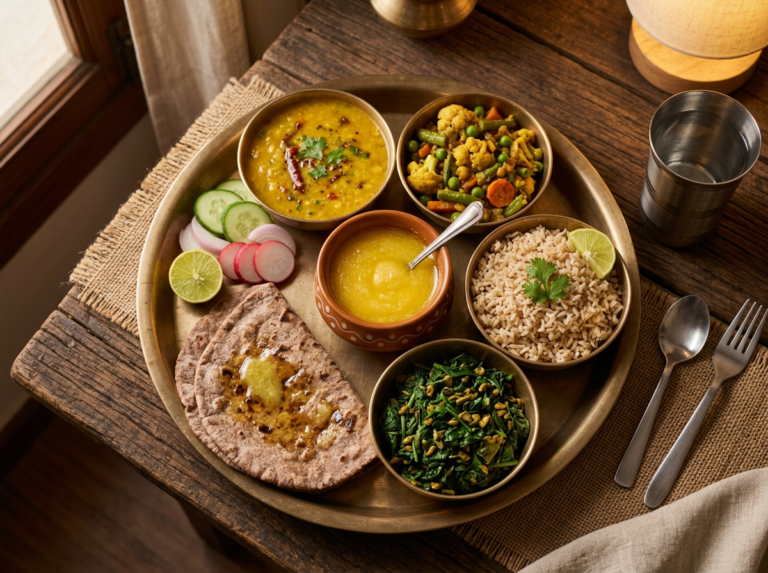
- With meals: Adding ghee to cooked rice, dal, or rotis at lunch or dinner improves the absorption of fat-soluble nutrients (vitamins A, D, E, K2, and carotenoids from vegetables) and reduces the glycaemic spike of the carbohydrates it accompanies.
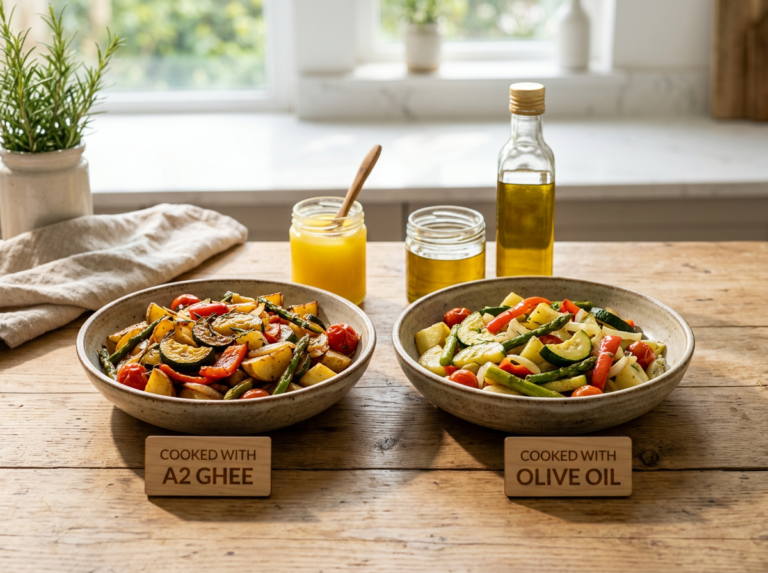
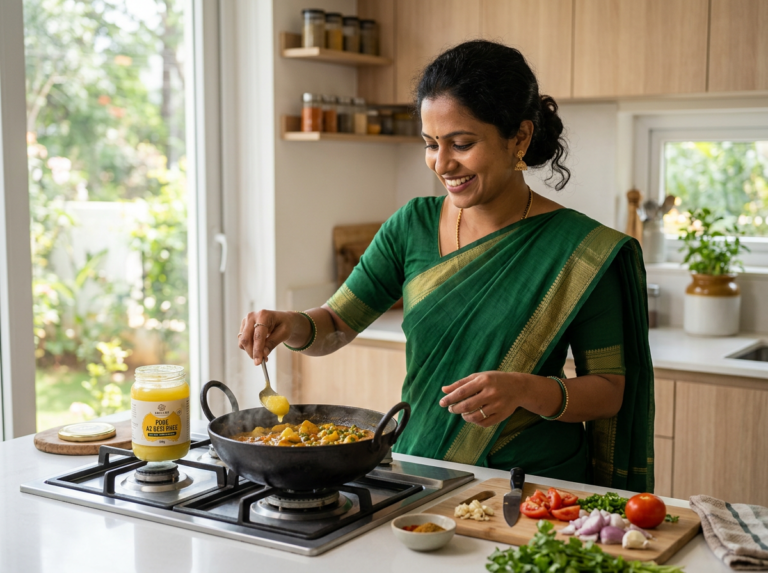
- For cooking: Using ghee as a cooking medium — especially for tadka (tempering spices) — is a practical way to include it in meals without tracking teaspoons separately. One teaspoon in a tadka for a dish serving four people distributes approximately 1.25 ml of ghee per person, a very moderate amount.
- Avoid late at night: Traditional guidance cautions against heavy fat intake close to bedtime when digestion slows. If you use ghee at dinner, earlier in the evening is better.
Seasonal Adjustments
Ayurveda adjusts dietary fat recommendations by season — a practice that has some grounding in how metabolism and digestion shift with temperature. In winter (Hemanta and Shishira ritu), digestive fire is stronger and the body needs more caloric density and lubrication; ghee intake can increase toward the 2-teaspoon end. In summer (Grishma), Pitta increases and digestion becomes sensitive; 1 teaspoon or less is appropriate. The monsoon season (Varsha) is when digestion is typically weakest, and Ayurveda recommends easily digestible foods including small amounts of ghee to support gut health without overburdening the system.
Practical Summary
For most healthy adults: 1–2 teaspoons of A2 ghee per day, used as a cooking medium or added to meals, is a well-supported and safe daily intake. Start with 1 teaspoon if you are new to ghee and see how your digestion responds before increasing. Quality matters significantly — large-scale ghee from crossbred cows using cream-separator methods does not offer the same fatty acid profile as traditionally made bilona ghee from A2 milk.
To try genuine bilona-method A2 ghee from Tamil Nadu native desi cows in Tamil Nadu, visit Raghas Dairy’s subscription page — a convenient way to ensure you always have quality ghee in your kitchen.