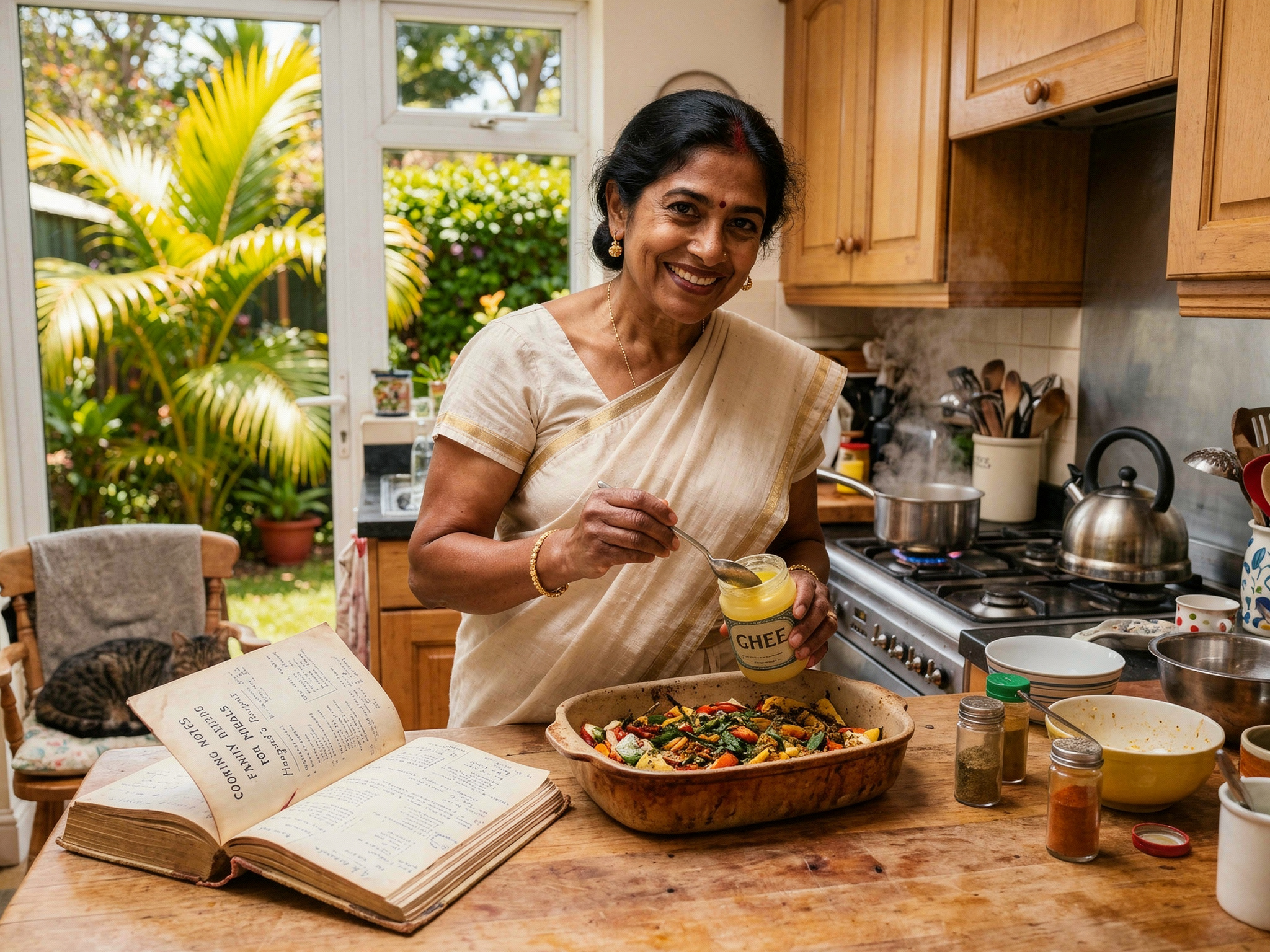
Best Ghee for Kids: Cooking Notes for Family Meals
Food note: This article is general food information, not medical advice. For babies, pregnancy, liver, heart, or diagnosed health conditions, please follow your doctor or dietitian’s guidance.
Best Ghee for Kids: Growth, Brain Development & Immunity
The best ghee for kids is A2 desi cow ghee made from native Indian breed milk using the traditional Bilona method. Children need healthy fats for brain development, bone growth, and immune strength — and ghee has been the go-to fat for Indian children for thousands of years. Modern nutrition science confirms what grandmothers always knew: ghee is essential for growing children.
This guide covers why ghee matters for kids, which type is best, an age-wise dosage guide, brain development benefits, immunity support, and easy ways to include ghee in your child’s diet.
Why Children Need Ghee
Children have fundamentally different nutritional needs than adults. Their bodies are building — brains, bones, organs — and this requires abundant healthy fats:
- 60% of the brain is fat — Children’s brains develop rapidly until age 6, requiring quality fats daily
- Fat-soluble vitamins need fat — Vitamins A, D, E, K can only be absorbed with dietary fat
- Calorie needs are high — Relative to body weight, children need more calories than adults
- Immune system is developing — Gut health (supported by ghee’s butyric acid) directly affects immune development
- Bone mineralisation — Vitamins D and K2 in ghee direct calcium to bones
The WHO and Indian Academy of Pediatrics recommend that 30-40% of children’s calories come from fat. A2 ghee is one of the healthiest fat sources available.
Boost your immunity with nutrient-rich A2 ghee
Which Ghee Is Best for Kids?
Not all ghee is created equal. Here’s what to look for:
| Factor | Best Choice | Avoid |
|---|---|---|
| Cow breed | Native Indian breeds (A2 milk) | Hybrid/Jersey (A1 milk) |
| Method | Traditional Bilona (curd-churned) | Industrial cream-separated |
| Feed | Pasture-raised, natural forage | Grain-fed, hormone-treated |
| Processing | Small-batch, wood/slow fire | Mass-produced, high-heat |
| Additives | None — pure ghee only | Added colour, flavour, preservatives |
Why A2 ghee specifically?
A2 beta-casein from native breeds is the original milk protein that human digestive systems evolved to process. A1 beta-casein (from Holstein/Jersey cows) produces BCM-7 during digestion — a peptide linked to digestive discomfort. For children’s developing guts, A2 is the safer choice. Learn more about A2 ghee’s nutrition.
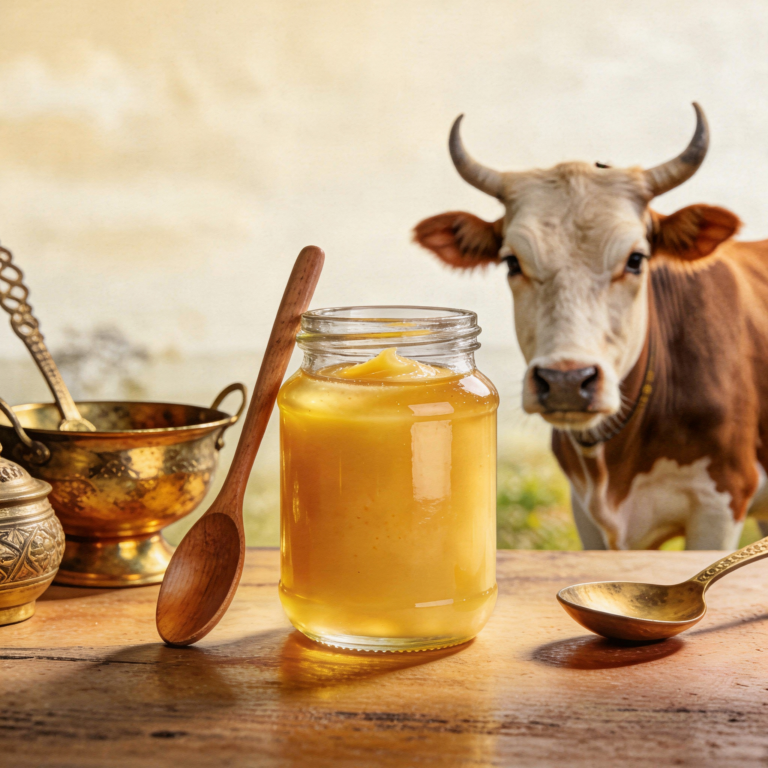
At Raghas Dairy, we make our ghee in Madurai from milk sourced from a mixed Tamil Nadu native desi cow herd. All Tamil Nadu native desi cow source produce pure A2 milk, and our traditional Bilona method preserves maximum nutrition.
A2 Ghee for Brain Development
This is perhaps the most important reason to give children ghee. Here’s the science:
Cholesterol for Brain Building
Ghee contains cholesterol — and that’s a good thing for children. Cholesterol is a building block for brain cell membranes (myelin sheath) and is essential for forming new neural connections. Children’s brains need dietary cholesterol for development.
Essential Fatty Acids
A2 ghee provides a balanced profile of saturated and unsaturated fatty acids. These support the formation of the myelin sheath — the insulating layer around nerve fibres that enables fast signal transmission (crucial for learning, memory, and motor skills).
Vitamin A (Retinol)
Vitamin A is critical for brain development and visual development. A2 ghee from grass-fed native cows is rich in bioavailable retinol — more readily used by the body than plant-based beta-carotene.
Omega Fatty Acids
While ghee isn’t the primary source of omega-3, it does contain small amounts and — more importantly — it dramatically improves absorption of omega-3 from other foods (fish, walnuts, flaxseeds) when consumed together.
Practical impact: Children who consume adequate healthy fats show better concentration, memory, and cognitive test scores. Traditional Indian diets — rich in ghee — supported brain development for millennia. Read about the full benefits of A2 ghee.
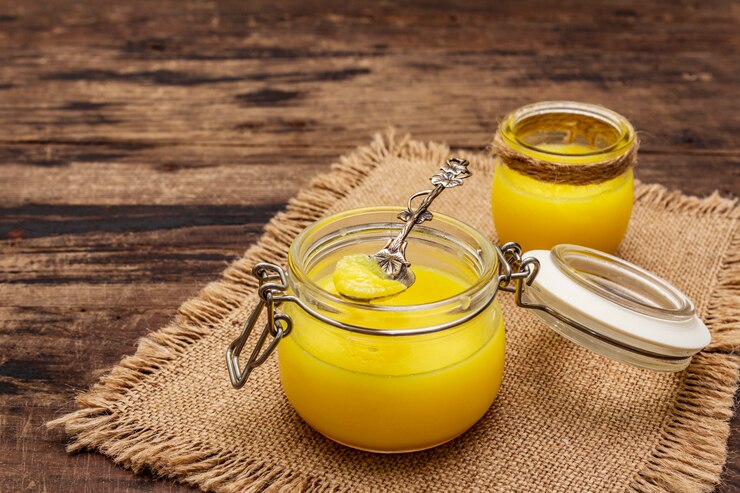
A2 Ghee for Children’s Immunity
Children catch infections frequently because their immune systems are still learning. A2 ghee supports immune development through:
- Butyric acid — Strengthens gut barrier (where 70% of immune cells develop). A strong gut = fewer infections
- Vitamin A — Maintains mucosal immunity in the nose, throat, and gut — the first line of defence against pathogens
- Vitamin D — Activates T-cells and macrophages. Deficiency (common in Indian children despite sunny climate) increases infection risk
- CLA — Modulates immune response, reducing both under-reaction and over-reaction (allergies)
Immunity-boosting recipes for kids:
- Warm milk + ½ tsp ghee + pinch of turmeric before bed
- Ghee rice with rasam (pepper + cumin + ghee = immunity trifecta)
- ½ tsp Chyawanprash mixed with ½ tsp ghee in warm milk
Bone Growth and Physical Development
A2 ghee supports strong bones through:
- Vitamin K2 — Directs calcium into bones and teeth (prevents it from depositing in soft tissues)
- Vitamin D — Increases calcium absorption from food by 30-40%
- Calorie density — Growing children need concentrated calories for growth spurts
- Lubrication of joints — Ghee supports joint flexibility in active, growing children
Age-Wise Ghee Guide for Children
| Age | Daily Ghee Amount | How to Give |
|---|---|---|
| 6-8 months | ¼ – ½ teaspoon | Mixed into mashed rice, dal, vegetable puree |
| 8-12 months | ½ – 1 teaspoon | In khichdi, porridge, mashed foods |
| 1-3 years | 1-2 teaspoons | On roti, in rice, with dal, in porridge |
| 3-6 years | 2-3 teaspoons | Cooking + topping on food |
| 6-10 years | 3-4 teaspoons | Regular cooking + drizzle on meals |
| 10-14 years | 1-2 tablespoons | As primary cooking fat + meal topping |
For guidance on introducing ghee to babies, see our dedicated guide on A2 ghee for babies.
Easy Ways to Include Ghee in Kids’ Diet
Even picky eaters won’t mind these:
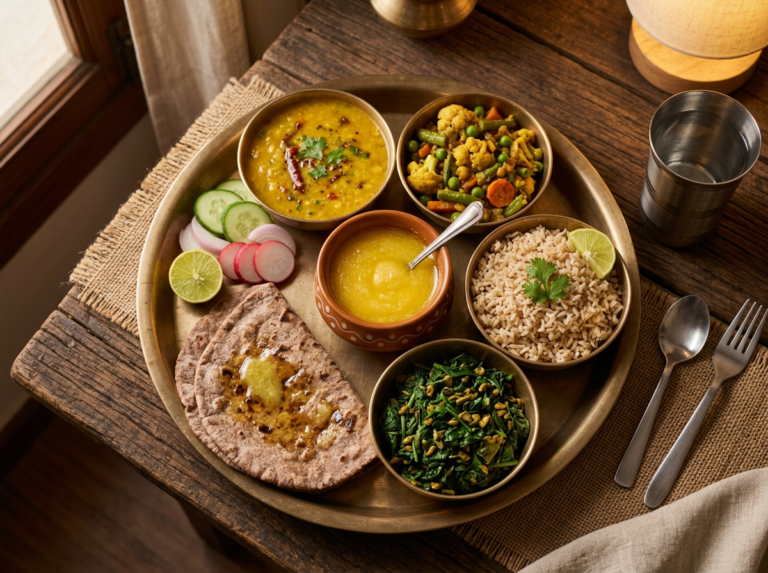
- Ghee rice — Mix a teaspoon of warm ghee into rice. Every Indian child loves this
- Ghee on hot roti/chapati — The classic. Ghee melts in and adds flavour
- Ghee in dal — Tadka with ghee or drizzle on top after serving
- Ghee parathas — Stuff with paneer, potato, or vegetables. Cook with ghee
- Ghee in porridge/oats — A spoonful in warm porridge with jaggery
- Ghee roasted vegetables — Sweet potato, carrots, beans sautéed in ghee
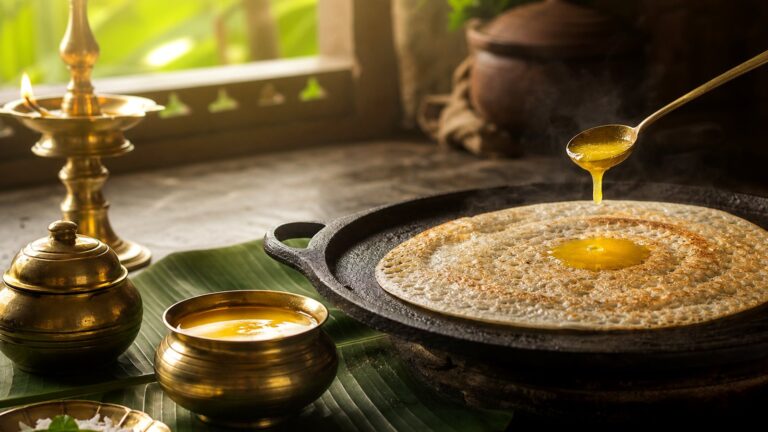
- Ghee with dosa/idli — Pour warm ghee instead of oil
- Ghee laddu — Homemade with nuts, dates, and ghee — a healthy snack
- Ghee banana mash — For toddlers: mashed banana + ½ tsp ghee
- Warm milk with ghee — Before bed: warm milk + ½ tsp ghee + pinch of turmeric
Common Parental Concerns
“Will ghee make my child fat?”
No. Childhood obesity is caused by excess sugar, junk food, and sedentary habits — not moderate amounts of traditional ghee. The fat in ghee is actually satiating, preventing overeating. Ghee provides healthy calories that support growth.
“Is ghee safe for my child’s cholesterol?”
Children need dietary cholesterol for brain development. The cholesterol in ghee (in recommended amounts) is beneficial, not harmful. Childhood cholesterol guidelines are different from adult guidelines.
“My child is lactose intolerant. Can they have ghee?”
Yes! Ghee is virtually lactose free after the clarification process. It’s one of the few dairy-derived foods safe for lactose intolerant children.
“regular market ghee vs homemade — which is safer?”
The safest option is traditionally made A2 ghee from a trusted source — like Raghas Dairy. regular market ghee may use A1 milk, industrial processes, and additives. Homemade is great if you can source A2 milk.
Frequently Asked Questions
Which ghee is best for kids?
A2 desi cow ghee from native Indian breeds, made using the traditional Bilona method. It has A2 protein (easier to digest), higher nutrient density, and no additives.
How much ghee should I give my child daily?
Babies (6-12 months): ½ tsp. Toddlers (1-3 years): 1-2 tsp. Children (3-8 years): 2-3 tsp. Older children (8-14 years): 1-2 tablespoons. Mix into food rather than giving straight.
Is ghee good for children’s brain development?
Yes. 60% of the brain is fat. A2 ghee provides cholesterol for brain cell membranes, fatty acids for myelin sheath, and vitamins A/D for cognitive development.
At what age can I start giving ghee to my baby?
From 6 months, when you introduce solid foods. Start with ¼ teaspoon mixed into mashed rice or dal. Ghee is well tolerated as it’s lactose free.
Key Takeaways
- A2 desi cow ghee (Bilona method, native breeds) is the best ghee for kids
- Children need healthy fats for brain development — 60% of the brain is fat
- Ghee’s butyric acid and vitamins A, D, K2 support immunity and bone growth
- Start from 6 months with ½ teaspoon, increase with age
- Mix into food — rice, dal, roti, porridge, milk — easy and delicious
- Ghee doesn’t cause childhood obesity — junk food and sugar do
Give Your Child the Best — Raghas A2 Ghee
Pure Bilona ghee made from milk sourced from Tamil Nadu native desi cows. No additives, no preservatives. Just traditional ghee made the right way for your child’s health.
Free shipping on orders above ₹1,750.
Written by the Raghas Dairy Team from Madurai, Tamil Nadu. We make A2 ghee from milk sourced from Tamil Nadu native desi cows using the traditional Bilona method — hand-churned from curd, slow-cooked over wood fire.
Frequently Asked Questions
What makes A2 desi ghee different from regular ghee?
A2 desi ghee is made from milk of indigenous cows that produce A2 beta-casein protein, which is easier to digest and more beneficial for health compared to A1 protein found in regular ghee.
How should I store desi ghee?
Store desi ghee in a cool, dry place away from direct sunlight. It can be kept at room temperature for months without refrigeration due to its natural preservation properties.
What are the traditional food value of consuming desi ghee?
Desi ghee is rich in fat-soluble vitamins (A, D, E, K), helps improve digestion, boosts immunity, and provides healthy fats that support everyday nourishment and overall health.