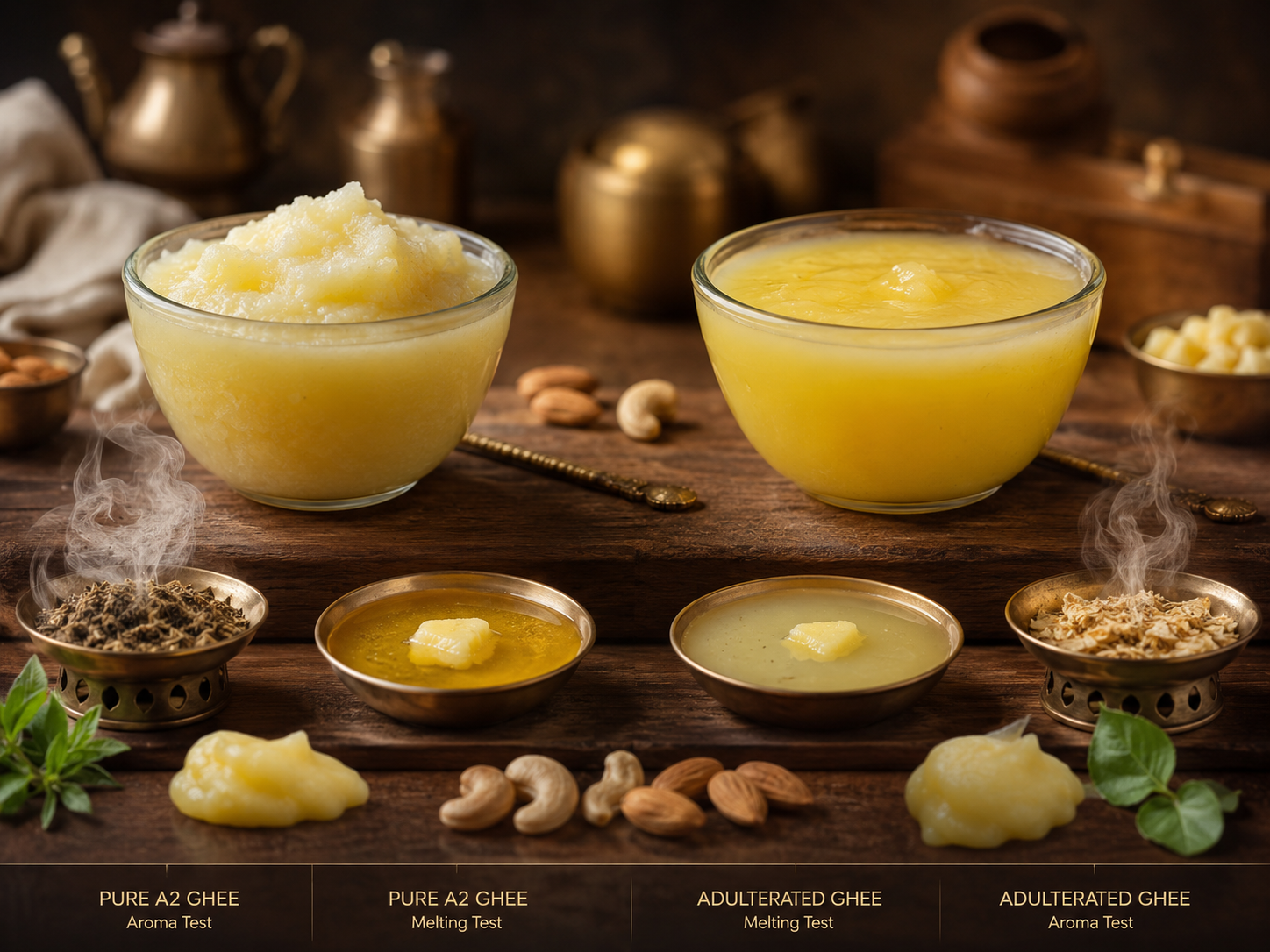
How to Identify Pure A2 Ghee – 7 Simple Tests (Buyer’s Guide 2
How to Identify Pure A2 Ghee – 7 Simple Tests (Buyer’s Guide 2026)
How to identify pure A2 ghee is the most important skill for any health-conscious ghee buyer. The A2 ghee market has flooded with fake, adulterated, and mislabelled products — regular ghee sold as “A2,” industrial cream-separated ghee labelled “bilona,” and worst of all, ghee mixed with vegetable oil or vanaspati.
The good news: genuine A2 bilona ghee has distinct physical characteristics that are difficult to fake. These 7 simple tests — most of which you can do at home in minutes — will protect you from paying premium prices for inferior products.
What Makes A2 Ghee “Pure”?
Genuinely pure A2 ghee requires three things:
- A2 milk source: From indigenous desi cow breeds (Kangayam, Umbalachery, Pulikulam, Bargur, Gir, Sahiwal) — not crossbred cattle
- Traditional bilona processing: Curd-churned, not cream-separated (why this matters)
- Zero additives: No preservatives, colours, flavours, or blending with other fats
When all three conditions are met, the ghee has distinct characteristics — golden colour, grainy texture, rich aroma, specific melting behaviour — that you can verify.
7 Simple Home Tests for A2 Ghee Purity
Test 1: The Colour Check
What to look for:
- ✅ Pure A2 ghee: Deep golden-yellow — from natural beta-carotene in grass-fed desi cow milk
- ❌ Pale/white: Indicates A1 milk, heavy processing, or buffalo ghee
- ❌ Bright yellow/orange: Artificial colouring added
- ❌ Grey: Over-heated or contaminated
Note: Colour naturally varies slightly by season — deeper in summer (more fresh grass), slightly lighter in winter. This is normal. Read seasonal variations below.
Test 2: The Grain Test
Method: Let the ghee cool to room temperature (or refrigerate briefly).
- ✅ Pure bilona A2 ghee: Forms visible crystals/grains — a natural result of its specific fatty acid composition
- ❌ Smooth and uniform: Likely cream-separated large-scale ghee or adulterated
This is one of the most reliable tests. The grainy texture of bilona ghee comes from its unique mix of saturated fatty acids crystallising at different rates. large-scale ghee has a different fatty acid ratio and stays smooth.
Test 3: The Palm Test
Method: Place a small amount on your palm and rub gently.
- ✅ Pure A2 ghee: Melts quickly from body heat (within seconds), absorbs into skin, leaves hands soft, no heavy residue
- ❌ Adulterated: Doesn’t melt easily, sits on skin surface, feels waxy, leaves greasy residue that’s hard to wash off
Pure ghee has a molecular structure similar to human sebum, so it absorbs naturally. Vegetable oil and vanaspati adulterants don’t share this property.
Test 4: The Hot Water Test
Method: Add 1 teaspoon ghee to a glass of hot water and stir.
- ✅ Pure A2 ghee: Melts completely, forms a clear golden layer on top, water stays clear
- ❌ Adulterated: Doesn’t melt properly, forms clumps, water becomes cloudy or milky, leaves particles
Test 5: The Aroma Test
Method: Open the jar and smell.
- ✅ Pure A2 bilona ghee: Rich, pleasant, nutty fragrance with sweet undertones — should make you want to eat it
- ❌ No smell: Over-processed or artificial
- ❌ Rancid/sour: Old, poorly stored, or low quality
- ❌ Chemical odour: Additives or adulterants present
Test 6: The Heat Test
Method: Heat a teaspoon of ghee in a small pan.
- ✅ Pure A2 ghee: Melts immediately, turns dark brown evenly, no sputtering
- ❌ Adulterated: Sputters (water content from mixing), takes longer to melt, may foam excessively
Test 7: The Iodine Test (for Starch Adulteration)
Method: Add 2-3 drops of iodine solution to melted ghee.
- ✅ Pure A2 ghee: No colour change
- ❌ Starch added: Turns blue/purple — indicates flour or starch mixed in as a thickener
Label Reading — What to Look For (and Red Flags)
Must-Have Label Information
- Cow breed specified: Kangayam, Umbalachery, Gir, Sahiwal, etc. — if they can’t name the breed, question the “A2” claim
- Processing method stated: “Bilona,” “curd-churned,” or “hand-churned” — not just “traditional”
- FSSAI license number
- Manufacturing date
- Ingredients: Should list only “cow milk” or “A2 cow milk ghee”
Red Flag Marketing Terms
- “Pure vegetarian ghee” — may not be from cows at all
- “Traditional recipe” — vague, doesn’t confirm A2 or bilona
- “Desi cow ghee” without breed — could be mixed A1/A2
- “100% natural” — legally meaningless
- “Farm fresh” — which farm? What breed? What method?
Pure ghee has a distinct golden clarity
Common Adulterants and How to Spot Them
Vegetable Oil Mixing
Paper test shows oil rings around the drop. Ghee doesn’t solidify properly when cooled. Lower smoke point.
Palm Oil
Orange tinge (not golden). Harder texture when solid. Waxy residue on palate.
Vanaspati (Hydrogenated Fat)
Artificially white or too uniform. Very hard when solid. No ghee aroma. Waxy mouthfeel.
Starch/Flour
Iodine test turns blue. Cloudy when melted. Thicker than pure ghee.
Price Reality Check
Understanding the economics helps you avoid fake products:
- 25-30 litres of A2 milk → 1 litre of bilona ghee
- A2 desi cow milk costs ₹60-80/litre in most regions
- Raw material cost alone: ₹1,500-2,400 per litre of ghee
- Add labour, processing, packaging: Minimum viable retail price is ₹1,500-1,800/litre
Bottom line: If “A2 bilona ghee” costs less than ₹1,200/litre, it is almost certainly not genuine. The math doesn’t work. Compare prices of verified brands in our best A2 ghee brands guide.
Seasonal Variations — Normal vs Suspicious
Pure A2 ghee from grass-fed cows naturally varies by season:
- Summer: Deeper golden, softer texture, stronger aroma (cows on fresh grass)
- Winter: Lighter golden, firmer texture, milder aroma (cows on dry fodder)
This variation is actually a sign of authenticity. If a brand’s ghee looks identical year-round, it may be over-processed or contain colour additives.
Your A2 Ghee Buyer’s Checklist
Before Purchase:
- ☐ Cow breed specified on label
- ☐ Bilona/curd-churned method confirmed
- ☐ Price above ₹1,200/litre
- ☐ FSSAI certified
- ☐ Positive verified reviews
Upon Delivery:
- ☐ Deep golden-yellow colour
- ☐ Rich nutty aroma
- ☐ Grainy texture when cool
- ☐ Manufacturing date is recent
Home Testing:
- ☐ Palm test — melts and absorbs quickly
- ☐ Hot water test — clear separation, water stays clear
- ☐ Heat test — melts immediately, no sputtering
- ☐ Taste — sweet, rich, nutty, no off-flavours
Building Trust with Your Supplier
Questions to ask any A2 ghee brand:
- What cow breeds do you use? (Must specify)
- Can you provide farm visit access? (Transparent operations welcome visitors)
- Do you have batch testing reports?
- What is your return/exchange policy? (Confident brands stand behind their product)
At Raghas Dairy, we welcome this scrutiny. Our A2 ghee comes from a mixed Tamil Nadu native desi cow herd — Kangayam, Umbalachery, Pulikulam, and Bargur — raised on natural pastures in Madurai. Every jar is bilona method, batch-traceable, and FSSAI certified.
Key Takeaways
- 7 simple tests can identify pure A2 ghee: colour, grain, palm, hot water, aroma, heat, and iodine tests.
- The grain test is most reliable — genuine bilona ghee forms visible crystals; large-scale ghee stays smooth.
- Price below ₹1,200/litre for “A2 bilona ghee” is a red flag — the economics don’t allow it.
- The label must specify cow breed and processing method. Vague terms like “traditional” or “farm fresh” mean nothing.
- Seasonal variation in colour/texture is normal and actually a sign of authenticity.
- Start with small orders from new brands, test quality, then buy in bulk.
Frequently Asked Questions
How can I test if ghee is pure A2 at home?
Use the palm test (melts quickly from body heat), grain test (forms crystals when cool), colour check (deep golden), and aroma test (rich, nutty). These 4 tests catch most fakes.
What is the price of genuine A2 ghee in India?
₹1,500-2,500/litre for genuine bilona A2 ghee. Below ₹1,200/litre is almost certainly not authentic.
What are the signs of fake ghee?
Pale colour, smooth texture (no graininess), bland smell, doesn’t melt on palm, waxy residue, price below ₹1,200/L, no breed or method on label.
Does pure ghee solidify in the fridge?
Yes — uniformly, maintaining golden colour, firm but scoopable. If it turns white, has uneven patches, or doesn’t solidify evenly, it may be adulterated.
A2 Ghee That Passes Every Test
Raghas Dairy — deep golden, grainy, intensely aromatic. Try it and test it yourself.
Free shipping on orders above ₹1,750
Frequently Asked Questions
What makes A2 desi ghee different from regular ghee?
A2 desi ghee is made from milk of indigenous cows that produce A2 beta-casein protein, which is easier to digest and more beneficial for health compared to A1 protein found in regular ghee.
How should I store desi ghee?
Store desi ghee in a cool, dry place away from direct sunlight. It can be kept at room temperature for months without refrigeration due to its natural preservation properties.
What are the traditional food value of consuming desi ghee?
Desi ghee is rich in fat-soluble vitamins (A, D, E, K), helps improve digestion, boosts immunity, and provides healthy fats that support everyday nourishment and overall health.