How to Store A2 Ghee Correctly
How to Store A2 Ghee: Shelf Life & Storage Tips for Maximum Freshness
Knowing how to store ghee properly is the difference between 12 months of fresh, aromatic ghee and a jar that goes rancid in weeks. Pure A2 desi cow ghee has an impressively long ghee shelf life of 6–12 months at room temperature—no refrigeration needed—but only if you follow a few simple rules. Moisture and contamination are ghee’s biggest enemies.
This guide covers everything: the best containers, ideal temperature, signs of spoilage, and whether you should refrigerate your ghee.
Why does ghee last so long? During the clarification process, all water content and milk solids (casein, lactose, whey) are removed from butter. What remains is 99.8% pure fat. Without moisture or protein, bacteria and mould have nothing to feed on—giving ghee one of the longest shelf lives of any cooking fat.
How Long Does Ghee Last?
| Storage Method | Shelf Life | Notes |
|---|---|---|
| Room temperature (cool, dark place) | 6–9 months | Standard for most Indian kitchens |
| Room temperature (airtight glass jar) | 9–12 months | Best practice for maximum shelf life |
| Refrigerated | 12–18 months | Extends life but ghee hardens—needs warming before use |
| Frozen | 24+ months | Indefinite in theory; may lose some aroma over time |
| Contaminated (wet spoon used) | 2–4 weeks | Moisture introduces bacteria; ghee spoils rapidly |
Key insight: Pure A2 Bilona ghee made from curd-cultured butter tends to last longer than cream-separated regular market ghee because the traditional process removes moisture more thoroughly.
Store ghee right to keep it fresh for months
5 Golden Rules for Storing Ghee
1. Always Use a Dry Spoon
This is the single most important rule. Even a drop of water introduced by a wet or damp spoon can cause ghee to develop mould within days. Always use a completely dry, clean spoon every time you scoop ghee from the jar.
2. Keep the Lid Tight
Exposure to air causes oxidation, which makes ghee taste stale. Always close the lid firmly after each use. Airtight containers are ideal.
3. Store Away from Heat and Sunlight
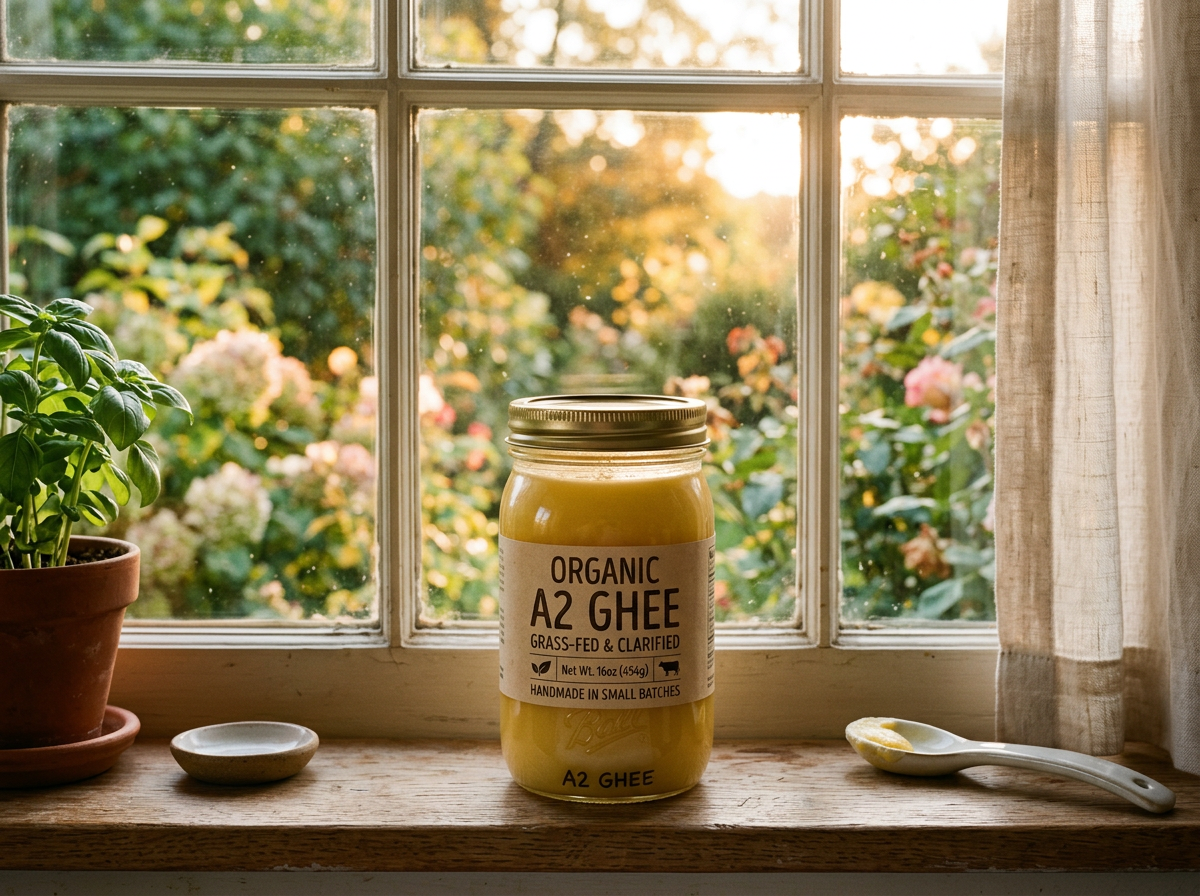
Place your ghee jar in a cool, dark cupboard—not next to the stove, oven, or on a windowsill. Heat accelerates oxidation, and UV light degrades vitamins A and E in ghee.
4. Avoid Double-Dipping
Never put a spoon back into the ghee jar after it has touched food. Food particles introduce bacteria and moisture. Scoop once, use, and return a clean spoon next time.
5. Don’t Mix Old and New Ghee
When you get a fresh jar, finish the old one first. Mixing old ghee with new can accelerate spoilage of the fresh batch. If you must combine them, ensure the old ghee is still perfectly fresh.
Key Takeaways: Ghee Storage
- Pure A2 ghee lasts 6–12 months at room temperature without refrigeration
- The #1 rule: ALWAYS use a dry spoon—moisture is ghee’s biggest enemy
- Store in an airtight glass jar in a cool, dark cupboard
- Refrigeration extends shelf life to 12–18 months but hardens the ghee
- Quality matters: Bilona-method A2 ghee lasts longer than large-scale ghee
- Signs of spoilage: sour smell, bitter taste, colour change, mould spots
Best Containers for Ghee
| Container Type | Rating | Why |
|---|---|---|
| Glass jar with airtight lid | Best | Non-reactive, easy to clean, doesn’t absorb odours, see-through for monitoring |
| Stainless steel container | Excellent | Durable, non-reactive, blocks light; traditional choice in Indian kitchens |
| Ceramic jar with lid | Good | Blocks light, non-reactive; ensure the glaze is food-safe |
| Food-grade plastic | Acceptable | Convenient but can absorb ghee odour over time; avoid if storing long-term |
| Brass or copper vessel | Traditional but risky | Can react with ghee over long periods; fine for short-term serving |
Pro tip: If your ghee comes in a good glass or steel container (like Raghas Dairy jars), simply keep it in the original packaging. No need to transfer.
Airtight storage preserves ghee goodness
Should You Refrigerate Ghee?
For most Indian households: No.
Ghee does not require refrigeration. In fact, refrigerating ghee has drawbacks:
- Ghee becomes rock-hard and difficult to scoop
- You’ll need to warm it before use, adding inconvenience
- Opening a cold jar repeatedly can cause condensation (moisture) inside—which actually shortens shelf life
When refrigeration makes sense:
- You live in a very hot, humid climate (coastal areas where kitchen temperatures exceed 35°C regularly)
- You bought ghee in bulk and won’t finish it within 6 months
- You want to freeze a portion for 12+ month storage
If you refrigerate, let the jar come to room temperature for 15–20 minutes before opening to avoid condensation.
Signs Your Ghee Has Gone Bad
- Sour or rancid smell: Fresh ghee has a sweet, nutty aroma. If it smells sour, acidic, or “off,” it’s oxidised.
- Bitter taste: Fresh ghee tastes mildly sweet and nutty. Bitterness indicates rancidity.
- Colour change: Fresh A2 ghee is golden-yellow. If it turns pale, greyish, or develops white spots, something’s wrong.
- Mould: Any visible mould (green, black, or white fuzzy spots) means moisture contamination. Discard the entire jar.
- Watery layer: Separation with a liquid layer at the bottom indicates moisture entry.
When in doubt, trust your nose. Rancid ghee has an unmistakable sour smell that’s very different from fresh ghee’s sweet aroma. If it smells wrong, don’t use it.
To ensure you’re buying pure ghee that stores well, read our guide on how to identify pure A2 ghee and ghee adulteration tests you can do at home.
Seasonal Storage Tips (Indian Climate)
Summer (March–June)
- Ghee will be liquid or semi-liquid—this is perfectly normal
- Keep it in the coolest part of your kitchen, away from the stove
- Consider refrigerating if kitchen temperatures consistently exceed 35°C
- Use smaller containers so you open and close the jar less frequently
Monsoon (July–September)
- Humidity is ghee’s enemy during monsoon—be extra careful with the dry spoon rule
- Ensure the lid seals tightly; moisture in the air can enter loosely closed jars
- Store away from windows and areas where condensation forms
Winter (October–February)
- Ghee will be solid and granular—this is the ideal storage state
- No special precautions needed; room temperature storage is perfect
- Best time to buy in bulk, as ghee keeps longest in cool weather
Common Ghee Storage Myths
Myth: Ghee must be refrigerated after opening
False. Unlike butter, ghee has virtually no moisture or milk solids, so it’s shelf-stable at room temperature. Refrigeration is optional, not necessary.
Myth: Ghee lasts forever
Partially true. In Ayurveda, aged ghee (purana ghrita) is highly valued and said to improve with age. However, this applies to ghee stored under ideal conditions in earthen pots. In a typical kitchen, 6–12 months is a realistic shelf life for optimal taste and nutrition.
Myth: Grainy/granular texture means ghee has gone bad
False. Granular texture in A2 Bilona ghee is actually a sign of quality and purity. It occurs when ghee is made from curd-churned butter and cooled naturally. It’s perfectly safe and normal.
Myth: You can scoop ghee with any spoon
Dangerous. A wet spoon introduces moisture, which causes mould and bacterial growth within days. Always use a dry, clean spoon.
Get Fresh, Long-Lasting A2 Ghee Delivered to Your Door
Raghas Dairy A2 ghee — made from milk sourced from Tamil Nadu native desi cows in Madurai. Bilona method, naturally long shelf life.
Free shipping on orders above ₹1,750 | Buying guide here
Frequently Asked Questions
Does ghee need to be refrigerated?
No. Pure ghee is shelf-stable at room temperature for 6–12 months because it contains no moisture or milk solids. Refrigeration is optional and only recommended for very hot/humid climates or bulk storage beyond 6 months.
How long does ghee last after opening?
Opened A2 ghee lasts 6–9 months at room temperature if stored properly (dry spoon, airtight lid, cool dark place). In the refrigerator, opened ghee can last 12–18 months.
Can ghee go bad?
Yes, although it takes much longer than most foods. Ghee can go rancid due to oxidation (exposure to air and light) or spoil due to moisture contamination (wet spoons). Signs include sour smell, bitter taste, colour changes, or visible mould.
Why is my ghee grainy or granular?
Granular texture in A2 ghee is a sign of purity and traditional preparation. It occurs in Bilona-method ghee made from curd-churned butter. It’s perfectly normal, safe, and actually indicates higher quality than perfectly smooth regular market ghee.
Can I freeze ghee?
Yes. Frozen ghee can last 24+ months. Freeze in airtight containers, leaving some space for expansion. Thaw in the refrigerator when needed. Freezing doesn’t significantly affect ghee’s nutritional value, though some aroma may be lost over very long periods.
Is it OK to use ghee that has melted and re-solidified?
Absolutely. Ghee naturally melts in warm weather and solidifies in cool weather. This cycle does not affect quality, taste, or safety. It’s the normal behaviour of pure ghee.
Storage Notes for A2 Desi Cow Ghee Buyers
For any A2 ghee brand, storage matters as much as the jar you buy. Keep the lid closed, use a clean dry spoon, and store the jar away from direct heat and water. Moisture is the main reason ghee quality drops after opening.
Always follow the best-before and storage guidance printed on the pack. If the aroma, colour or texture changes unusually, contact the brand before using it. For Raghas customers, order support is available through the contact details on the site.
Continue Your A2 Ghee Buying Research
If you are choosing A2 desi cow ghee for your home, compare source clarity, bilona method, price per litre, storage guidance and delivery support before ordering.