A2 Ghee and Heart-Friendly Cooking: What Buyers Should Know
Food note: This article is general food information, not medical advice. For babies, pregnancy, liver, heart, or diagnosed health conditions, please follow your doctor or dietitian’s guidance.
Ghee and heart disease occupy an uncomfortable space in Indian health conversations. For decades, doctors advised patients to reduce or eliminate ghee from their diet on the basis that saturated fat causes heart disease. Many Indian families stopped using ghee they had consumed for generations and replaced it with refined sunflower or canola oil. The science behind that advice has since been substantially revised — and some of the replacements may have been worse for balanced eating than the ghee they displaced. This article examines what the current evidence actually says about A2 desi cow ghee and heart health.
The Saturated Fat Narrative: What Changed
The idea that dietary saturated fat causes heart disease originates largely from Ancel Keys’ Seven Countries Study in the 1960s, which found a correlation between saturated fat intake and heart disease rates across countries. That study later faced significant criticism for cherry-picking data from seven countries while ignoring data from 16 others that did not fit the hypothesis.
A landmark 2010 meta-analysis in the American Journal of Clinical Nutrition (Siri-Tarino et al.) pooled data from 21 prospective studies covering 347,747 subjects and found no significant association between saturated fat consumption and cardiovascular disease or stroke. A 2016 analysis published in the British Medical Journal (the PURE study, covering 18 countries across 5 continents) found that higher total fat and saturated fat intake was associated with lower cardiovascular mortality, while high carbohydrate intake was associated with higher mortality.
These are large, well-conducted studies — not fringe findings. The medical consensus is shifting, though dietary guidelines often lag behind research by a decade or more.
Vitamin K2 and Arterial Health
One of the most compelling arguments for moderate ghee consumption in the context of heart health is its vitamin K2 content. K2 (specifically the MK-4 form present in animal fat) activates matrix Gla protein (MGP), which inhibits calcium from depositing in arterial walls. Arterial calcification — the hardening of arteries — is a major independent risk factor for heart disease, distinct from cholesterol levels.
The Rotterdam Study, a long-running Dutch cohort study, found that higher dietary K2 intake was significantly associated with lower cardiovascular mortality, lower aortic calcification, and lower all-cause mortality. K2 is found primarily in animal fats (including ghee, butter, and egg yolk) and fermented foods — food categories that many health-conscious Indians have reduced in recent decades. Increasing quality ghee consumption as part of a traditional diet may be one way to improve K2 status.
CLA, Omega-3, and Cardiovascular Markers
A2 ghee from grass-fed desi cows contains conjugated linoleic acid (CLA) and alpha-linolenic acid (ALA, an omega-3 fatty acid) in amounts that are higher than grain-fed cow ghee. Both have cardiovascular implications:
- CLA: Research in both animal models and human trials suggests CLA may modestly reduce LDL cholesterol, improve HDL:LDL ratios, and reduce atherosclerotic plaque formation. A 2000 study in the Journal of Nutritional Biochemistry found CLA-supplemented subjects showed reduced total cholesterol and LDL levels.
- Omega-3 fatty acids: The omega-3:omega-6 ratio in A2 desi cow ghee is significantly better than that of refined vegetable oils. Chronic imbalance toward omega-6 is pro-inflammatory; omega-3 is anti-inflammatory. Ghee from pasture-raised cows, with a ratio closer to 1:1.5 vs the 1:15+ ratio in sunflower oil, contributes to a less inflammatory dietary profile.
Smoke Point and Oxidation: The Seed Oil Problem
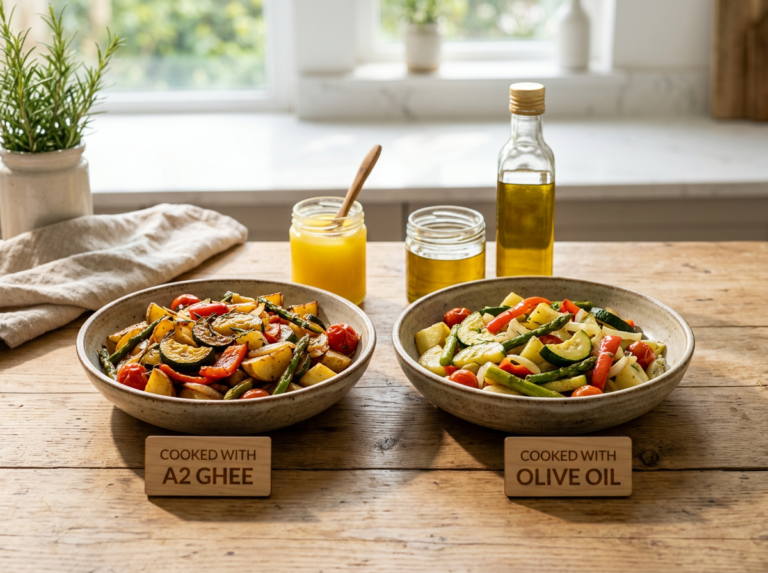
An underappreciated aspect of cooking fat choice and cardiovascular risk is what happens to the fat when it is heated. Refined seed oils — sunflower, soybean, canola — have unsaturated fatty acids that are chemically unstable at high temperatures. When heated to typical Indian cooking temperatures (180–220°C for tadka and frying), these oils oxidise and produce aldehydes, particularly 4-hydroxynonenal (4-HNE), which is toxic to cellular mitochondria and has been linked to cardiovascular disease, liver damage, and neurodegenerative conditions.
A 2015 study from De Montfort University analysed aldehydes produced by common cooking oils at frying temperatures. Corn oil and sunflower oil produced up to 20 times more toxic aldehydes than coconut oil or butter. Ghee, with its high smoke point of 252°C and predominantly saturated fat structure, produces negligible aldehydes at typical Indian cooking temperatures. The stability of ghee under heat — not just its composition at room temperature — is a significant advantage over refined vegetable oils for balanced eating.
Moderation and Context
None of the above is an argument for unlimited ghee consumption. Balanced eating is determined by the totality of diet, activity, stress, sleep, and native cow source — not any single food. The evidence suggests that replacing refined seed oils with 1–2 teaspoons of quality A2 ghee per day, within a diet rich in vegetables, pulses, and whole grains, is a sensible shift that is unlikely to increase cardiovascular risk and may reduce it through the K2, CLA, and cooking-stability mechanisms described above.
People with diagnosed heart disease, very high LDL cholesterol, or familial hypercholesterolaemia should consult their cardiologist before making dietary changes. For everyone else, the evidence no longer supports avoiding traditional desi cow ghee — particularly when the alternative is refined vegetable oil used at high heat.
For quality-verified A2 bilona ghee made from Tamil Nadu native desi cows, visit raghasdairy.com/shop.