Kangayam Cow Ghee: Taste, Price and Why It Is Special
Kangayam Cow Ghee: Benefits, Price & Why It’s Special
Kangayam cow ghee is A2 ghee made from the milk of Kangayam cattle — a powerful, drought-resistant native breed from western Tamil Nadu. Kangayam cows produce low-volume but high-fat A2 milk (4.5–5.5% fat), yielding ghee that’s exceptionally rich in flavour, golden in colour, and dense in nutrition. No other large-scale A2 ghee brand highlights this breed — and that’s exactly why it matters.
At Raghas Dairy, Kangayam is part of the wider Tamil Nadu native desi cow heritage we respect, while our farm source is described as a mixed Tamil Nadu native desi cow herd. This article shares everything we know about the Kangayam specifically — its history, milk quality, and why its ghee is genuinely different from the Gir or Sahiwal ghee that dominates the market.
The Kangayam Breed: History & Heritage
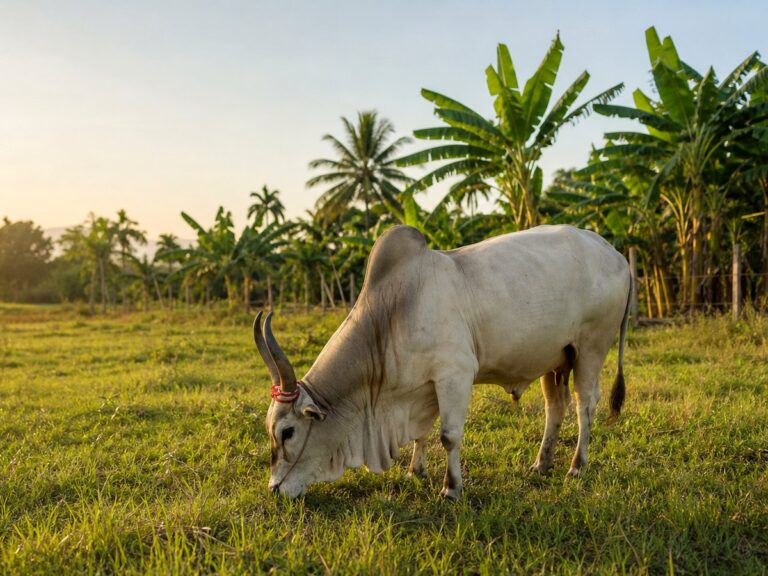
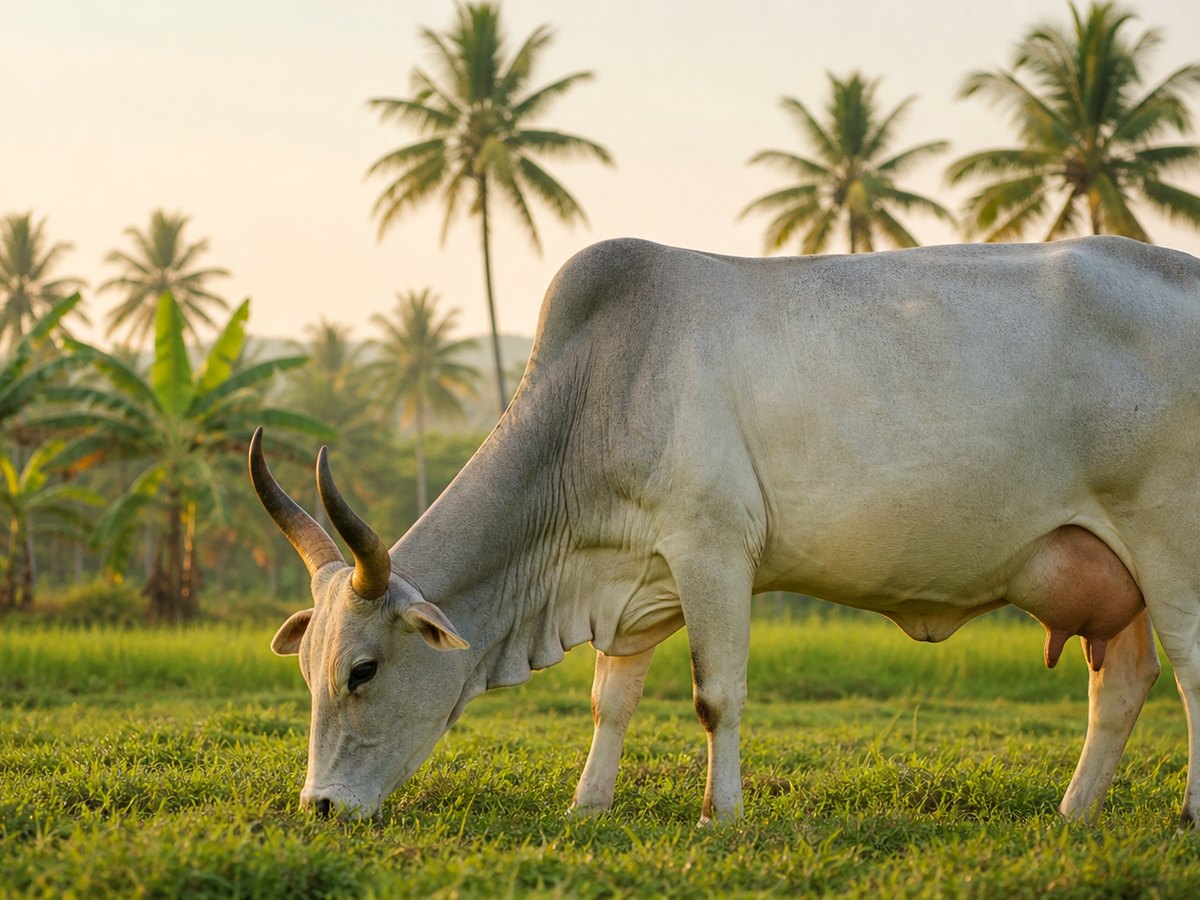
The Kangayam (also spelled Kangeyam) is one of India’s most respected native cattle breeds. Originating from the Kangayam region of present-day Tirupur district in western Tamil Nadu, these cattle have been bred for centuries as dual-purpose animals — powerful draught workers and producers of rich A2 milk.
Historical Significance
- Origin: Kangayam taluk, Tirupur district, western Tamil Nadu. The breed is named after its homeland.
- Age: References to Kangayam-type cattle in Tamil Sangam literature suggest the breed is at least 2,000 years old.
- Royal patronage: The Pattagar of Palayakottai and other local chieftains maintained prized Kangayam herds. The breed was a symbol of agricultural wealth and regional pride.
- Draught power: Before mechanisation, Kangayam bulls were the backbone of agriculture in western Tamil Nadu — ploughing fields, pulling carts, and operating oil presses. Their strength and endurance were legendary.
- Jallikattu connection: Kangayam bulls are among the most prized breeds in Jallikattu (Tamil Nadu’s traditional bull-taming sport). The breed’s speed, agility, and temperament make it a favourite.
Conservation Status
The Kangayam breed has faced significant decline since the 1970s due to mechanisation (reducing demand for draught power) and crossbreeding programmes. The National Bureau of Animal Genetic Resources (NBAGR) has registered the breed, and conservation efforts by Tamil Nadu’s Animal Husbandry Department and private breeders are ongoing. Supporting Kangayam ghee production directly supports breed conservation.
Nei sadam — classic South Indian ghee rice
Physical Characteristics of Kangayam Cattle
Kangayam cattle are instantly recognisable:
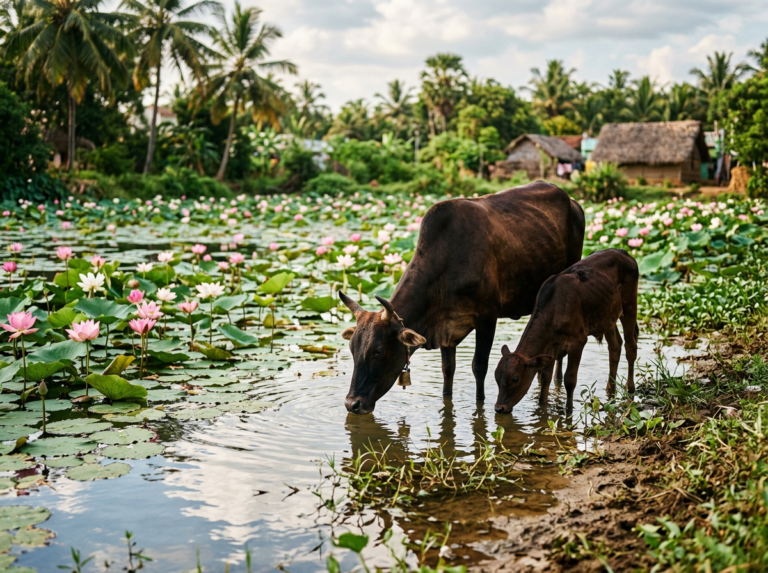
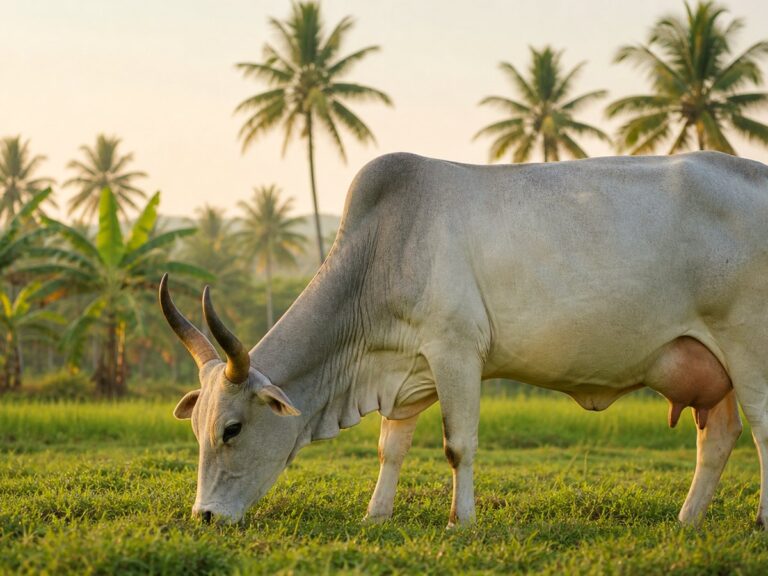
- Colour: Grey to white coat. Calves are born reddish-brown and lighten with age. Bulls are often darker, especially around the hump and forequarters.
- Horns: Medium-length, curve backward and slightly outward — a signature feature.
- Build: Compact, muscular, and sturdy. Bulls have a prominent hump. The body is well-proportioned for both draught work and endurance.
- Size: Medium-framed. Bulls weigh 400–500 kg; cows 300–350 kg.
- Temperament: Alert, spirited, and hardy. Kangayam cattle are known for their ability to thrive in hot, dry conditions with minimal veterinary intervention.
- Adaptations: Evolved for the semi-arid western Tamil Nadu climate. Heat-tolerant, disease-resistant, and efficient on low-quality forage.
Kangayam A2 Milk: What Makes It Different
All Indian native (desi) cattle breeds produce A2 beta-casein milk. But Kangayam milk stands out within this category for several reasons:
Higher Fat Content
Kangayam cows produce milk with 4.5–5.5% fat content, compared to 3.5–4.5% for most other native breeds and 3.0–3.5% for crossbreeds. This means:
- More ghee per litre of milk
- Richer, creamier taste
- Higher concentration of fat-soluble vitamins per serving
Low Volume, High Quality
A Kangayam cow gives only 3–5 litres of milk per day. Compare this to a Holstein-Friesian (HF) cow at 15–25 litres. But this lower volume means the milk is more concentrated — more solids, more flavour, more nutrition per drop.
Think of it like comparing a concentrated cold-press juice to a diluted one. Less volume, more substance.
Pure A2 native cow source
Kangayam cattle have never been crossbred with European dairy breeds at scale. Their A2 native desi cow source is clear and uncontaminated — unlike many herds in northern India where crossbreeding with HF and Jersey cattle has been widespread.
For a complete overview of all Tamil Nadu breeds and their milk quality, see our Tamil Nadu native cow breeds guide.
Ghee rice — simple, fragrant, and nutritious
Kangayam Cow Ghee Benefits
The benefits of Kangayam cow ghee stem from three factors: the A2 milk source, the Bilona production method, and the breed’s unique milk composition.
Nutritional Benefits
- Rich in Vitamin A: The deep golden colour indicates high beta-carotene content, which converts to Vitamin A — essential for vision, immunity, and skin health.
- Vitamin K2: Important for directing calcium to bones and away from arteries. Ghee from grass-fed native breeds is one of the best dietary sources of K2.
- Butyric acid: A short-chain fatty acid that feeds beneficial gut bacteria, supports intestinal lining integrity, and has anti-inflammatory properties.
- CLA (Conjugated Linoleic Acid): Found in higher concentrations in ghee from grass-fed native cows. Associated with anti-inflammatory and metabolic benefits.
- Omega-3 to Omega-6 ratio: Better balanced than ghee from grain-fed or crossbreed cows.
Practical Benefits
- High smoke point (~250°C): Safe for all Indian cooking methods — tadka, frying, roasting.
- Distinct aroma: Kangayam ghee has a deep, nutty, slightly sweet fragrance that’s different from ghee made from Gir or Sahiwal milk. Our customers consistently note this.
- Grainy texture: When solidified, genuine Bilona Kangayam ghee has a characteristic granular texture — a sign of purity and traditional preparation.
- Lactose-free: Milk solids are removed during the Bilona process, making it safe for most lactose-intolerant individuals.
- Long shelf life: 12–18 months when stored properly — no preservatives needed.
Ayurvedic Perspective
In Ayurveda, ghee from native desi cows (go-ghrita) is considered the most sattvic fat — promoting mental clarity, digestive strength (agni), and overall vitality (ojas). Kangayam ghee, being from a breed deeply rooted in the Tamil tradition, aligns with Siddha medicine practices common in Tamil Nadu.
Explore the full spectrum of A2 ghee traditional food value in our detailed benefits article.
Kangayam vs Gir Cow Ghee: How They Compare
Most A2 ghee brands in India use Gir cow milk (from Gujarat/Rajasthan). Here’s how Kangayam ghee differs:
- Breed origin: Kangayam — Tamil Nadu (South India) | Gir — Gujarat (West India)
- Milk yield: Kangayam 3–5 L/day | Gir 6–12 L/day
- Milk fat %: Kangayam 4.5–5.5% | Gir 4.0–5.0%
- Availability: Kangayam — rare, limited herds | Gir — more widely available
- Ghee colour: Kangayam — deep golden | Gir — golden yellow
- Aroma: Kangayam — intense, nutty | Gir — mild, sweet
- A2 purity: Both are pure A2 ✅
- Market presence: Kangayam — niche, very few brands | Gir — dozens of brands
Key distinction: Kangayam ghee is rarer and more concentrated due to the breed’s lower milk volume and higher fat content. This makes it a premium product. Raghas Dairy raises a mixed Tamil Nadu native desi cow herd — Kangayam, Umbalachery, Pulikulam, and Bargur — and Kangayam is one of the key contributors to our ghee’s distinctive flavour profile.
Neither breed is “better” in absolute terms — both produce excellent A2 ghee. But for those who value South Indian tradition, local breed conservation, and maximum fat concentration, Kangayam is the clear choice.
The Raghas Dairy Connection
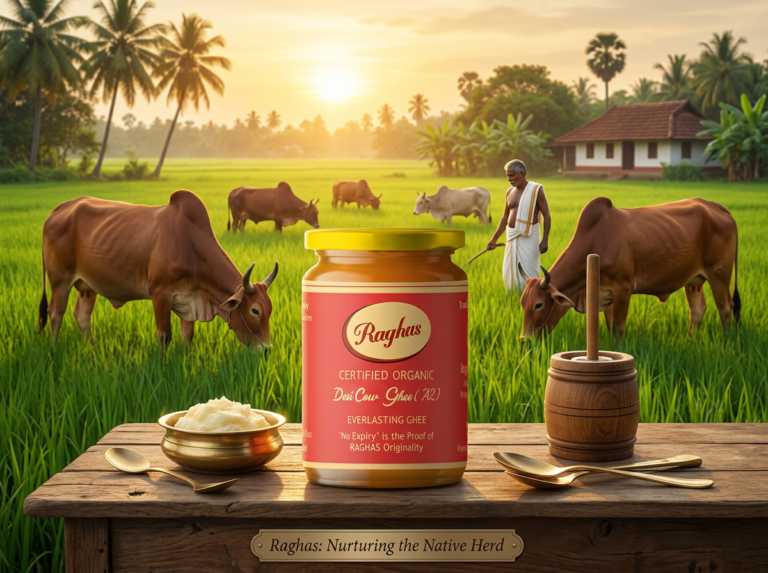
Raghas Dairy was founded in Madurai with a specific mission: to produce A2 ghee from all four of Tamil Nadu’s native breeds — Kangayam, Umbalachery, Pulikulam, and Bargur — not from breeds brought in from other states.
Here’s what that means in practice:
- We raise Kangayam, Umbalachery, Pulikulam, and Bargur cattle at our farm in the Madurai region
- We raise our own herds of all Tamil Nadu native desi cow source — supporting the breeds’ survival directly
- Every batch is made via the traditional Bilona method: curd from whole milk → hand churning → butter → slow-heated ghee
- We raise our own herds — no unknown aggregators or middlemen
When you buy ghee from Raghas, you’re not just buying a jar of ghee. You’re supporting a mixed Tamil Nadu native desi cow herd, farmers who maintain traditional herds, and a production method that’s been used for centuries in this region. The Kangayam is one vital part of that ecosystem.
Kangayam Cow Ghee Price: What to Expect
Genuine Kangayam cow Bilona ghee is a premium product. Here’s the realistic pricing landscape:
- ₹2,000–₹2,500/litre: Direct from dairy, bulk orders. Best value.
- ₹2,500–₹3,500/litre: Single jar, retail purchase. Standard for genuine product.
- Below ₹1,500/litre: Unlikely to be pure Kangayam Bilona ghee. May be mixed or cream-separator method.
Why the premium?
- Kangayam cows yield only 3–5 litres of milk/day
- 25–30 litres of milk → 1 litre of Bilona ghee
- Breed is rare — fewer cows = less supply
- Bilona process is manual and time-intensive
- No shortcuts, no mixing, no large-scale methods
Read more about ghee pricing in our article on why A2 ghee is expensive.
Raghas Dairy offers free shipping on orders above ₹1,750. Shop Kangayam Cow Ghee →
How to Buy Genuine Kangayam Cow Ghee
Because “Kangayam” is not a protected label, some sellers may use the name loosely. To ensure you’re getting the real thing:
- Buy from Tamil Nadu-based dairies that specifically work with Kangayam cattle.
- Check the breed disclosure on the label — it should say Kangayam, not just “desi cow.”
- Verify the dairy’s location — genuine Kangayam ghee comes from western and central Tamil Nadu (Tirupur, Erode, Madurai, Dindigul region).
- Ask about the source — a genuine dairy can tell you about their cattle network.
- Test the ghee — real Kangayam Bilona ghee has a deep golden colour, grainy texture, and intense nutty aroma.
Compare with our best A2 ghee brands guide for a broader market view.
Key Takeaways
- Kangayam is a native Tamil Nadu cattle breed producing high-fat (4.5–5.5%) pure A2 milk.
- Kangayam ghee is rarer, more concentrated, and distinctively aromatic compared to Gir/Sahiwal ghee.
- The breed is at conservation risk — buying Kangayam ghee supports breed preservation.
- Genuine Kangayam Bilona ghee costs ₹2,000–₹3,500/litre. Lower prices are a red flag.
- Raghas Dairy raises a mixed Tamil Nadu native desi cow herd — including Kangayam — at their farm in the Madurai region.
Frequently Asked Questions
What is special about Kangayam cow ghee?
Kangayam cows are a native Tamil Nadu breed that produce pure A2 milk with higher fat content (4.5–5.5%) than most dairy breeds. Their ghee has a distinctive golden colour, rich aroma, and grainy texture. The breed is naturally hardy, raised on dry-land grazing, and produces concentrated, nutrient-dense milk — making the ghee exceptionally high in fat-soluble vitamins and CLA.
Is Kangayam cow ghee better than Gir cow ghee?
Both are excellent A2 ghee from native Indian breeds. Kangayam ghee is distinct because the breed is adapted to the dry, hot climate of western Tamil Nadu, producing milk with higher fat concentration. Gir cows produce more volume but with slightly lower fat percentage. The nutritional profile of both is A2-positive. The choice often comes down to regional preference and supporting local breeds.
What is the price of Kangayam cow ghee?
Genuine Kangayam cow ghee made via the Bilona method typically costs ₹2,000–₹3,500 per litre. The higher price reflects the breed’s low milk yield (3–5 litres/day), the labour-intensive Bilona process, and the rarity of pure Kangayam herds. Mass-market ghee labelled “Kangayam” at significantly lower prices may not be from purebred Kangayam cows.
Where can I buy genuine Kangayam cow ghee?
Buy directly from dairies that raise Kangayam cattle in Tamil Nadu. Raghas Dairy raises a mixed Tamil Nadu native desi cow herd — Kangayam, Umbalachery, Pulikulam, and Bargur — at their farm in the Madurai region and produces Bilona ghee. Direct purchase ensures breed authenticity and traceability.
How much milk does a Kangayam cow give per day?
A Kangayam cow typically gives 3–5 litres of milk per day, compared to 15–25 litres from crossbreed or HF cows. While the volume is lower, Kangayam milk has higher fat content (4.5–5.5%) and is pure A2, making it ideal for premium ghee production.
About the Author: This article is written by the Raghas Dairy Team from Madurai, Tamil Nadu. We produce A2 Desi Cow Ghee from Tamil Nadu native breeds — Kangayam, Umbalachery, Pulikulam, and Bargur — using the traditional Bilona method. The Kangayam is one of Tamil Nadu native desi cow heritage we raise, alongside Umbalachery, Pulikulam, and Bargur.
Shop Raghas Kangayam Cow Ghee — Free Shipping Above ₹1,750 →
Frequently Asked Questions
What makes A2 desi ghee different from regular ghee?
A2 desi ghee is made from milk of indigenous cows that produce A2 beta-casein protein, which is easier to digest and more beneficial for health compared to A1 protein found in regular ghee.
How should I store desi ghee?
Store desi ghee in a cool, dry place away from direct sunlight. It can be kept at room temperature for months without refrigeration due to its natural preservation properties.
What are the traditional food value of consuming desi ghee?
Desi ghee is rich in fat-soluble vitamins (A, D, E, K), helps improve digestion, boosts immunity, and provides healthy fats that support everyday nourishment and overall health.