Tamil Nadu Native Cow Breeds & Their A2 Milk: Complete Guide
Tamil Nadu Native Cow Breeds & Their A2 Milk: Complete Guide
Tamil Nadu has four recognised native cow breeds: Kangayam, Umbalachery, Pulikulam, and Bargur. All four produce pure A2 beta-casein milk, are registered with NBAGR, and have never been crossbred with European dairy cattle. These breeds are among India’s most heat-adapted, disease-resistant cattle — and their milk makes some of the finest A2 ghee available.
Yet most A2 ghee brands in India focus on Gir (Gujarat) and Sahiwal (Punjab) cows. Tamil Nadu’s own native breeds rarely get the attention they deserve. This guide changes that — covering each breed’s history, characteristics, milk quality, conservation status, and why they matter for A2 dairy.
Overview: Tamil Nadu’s Four Native Cattle Breeds
Tamil Nadu’s cattle heritage is shaped by its geography — hot, semi-arid plains in the west, fertile river deltas in the east, hilly forest terrain in the south. Each breed evolved to thrive in its specific region:
- Kangayam: Western Tamil Nadu (Tirupur, Erode, Coimbatore) — the draught powerhouse
- Umbalachery: Cauvery Delta (Nagapattinam, Thanjavur) — the rice paddy worker
- Pulikulam: Southern Tamil Nadu (Madurai, Sivaganga, Ramanathapuram) — the Jallikattu breed
- Bargur: Bargur Hills, Erode district — the hill cattle
All four are classified as Bos indicus (zebu cattle) — the indigenous Indian cattle type. Unlike Bos taurus (European breeds like Holstein-Friesian and Jersey), zebu cattle carry the A2 allele for beta-casein protein.
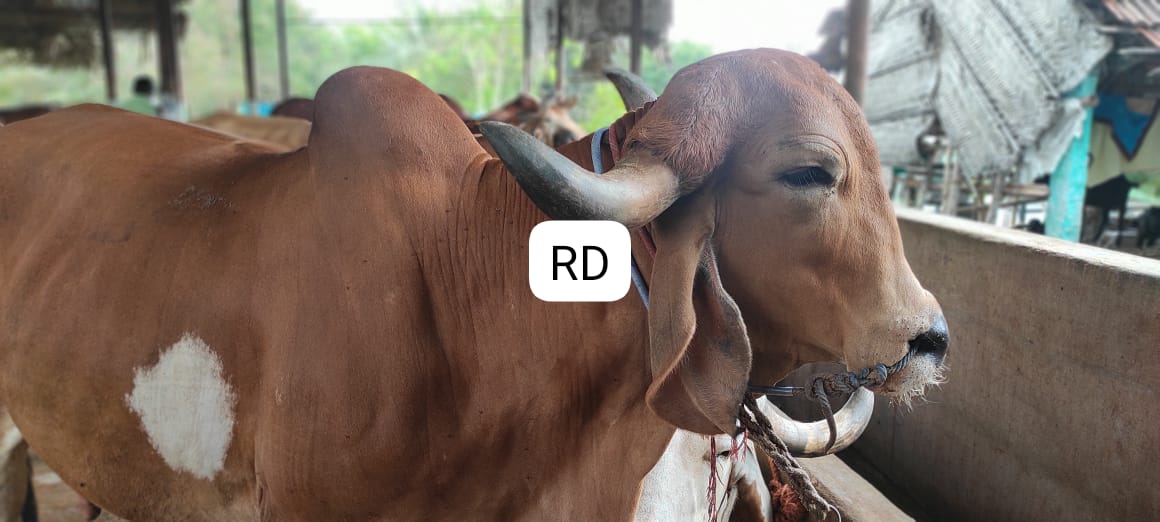
Kangayam: The Draught Powerhouse of Western Tamil Nadu
Origin & History
The Kangayam breed hails from the dry, black-soil plains around Kangayam taluk in Tirupur district. Historically maintained by wealthy landowners (Pattagars), these cattle were the agricultural engines of western Tamil Nadu — ploughing fields, hauling goods, and operating oil mills.
The breed was systematically developed through selective breeding by the Pattagar of Palayakottai, whose herd became the gold standard. This careful breeding over centuries produced an animal of remarkable strength, endurance, and adaptability.
Physical Characteristics
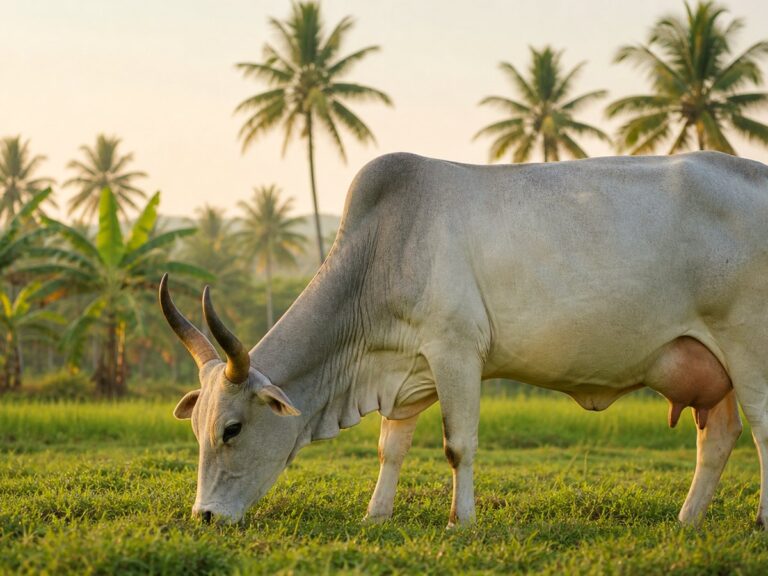
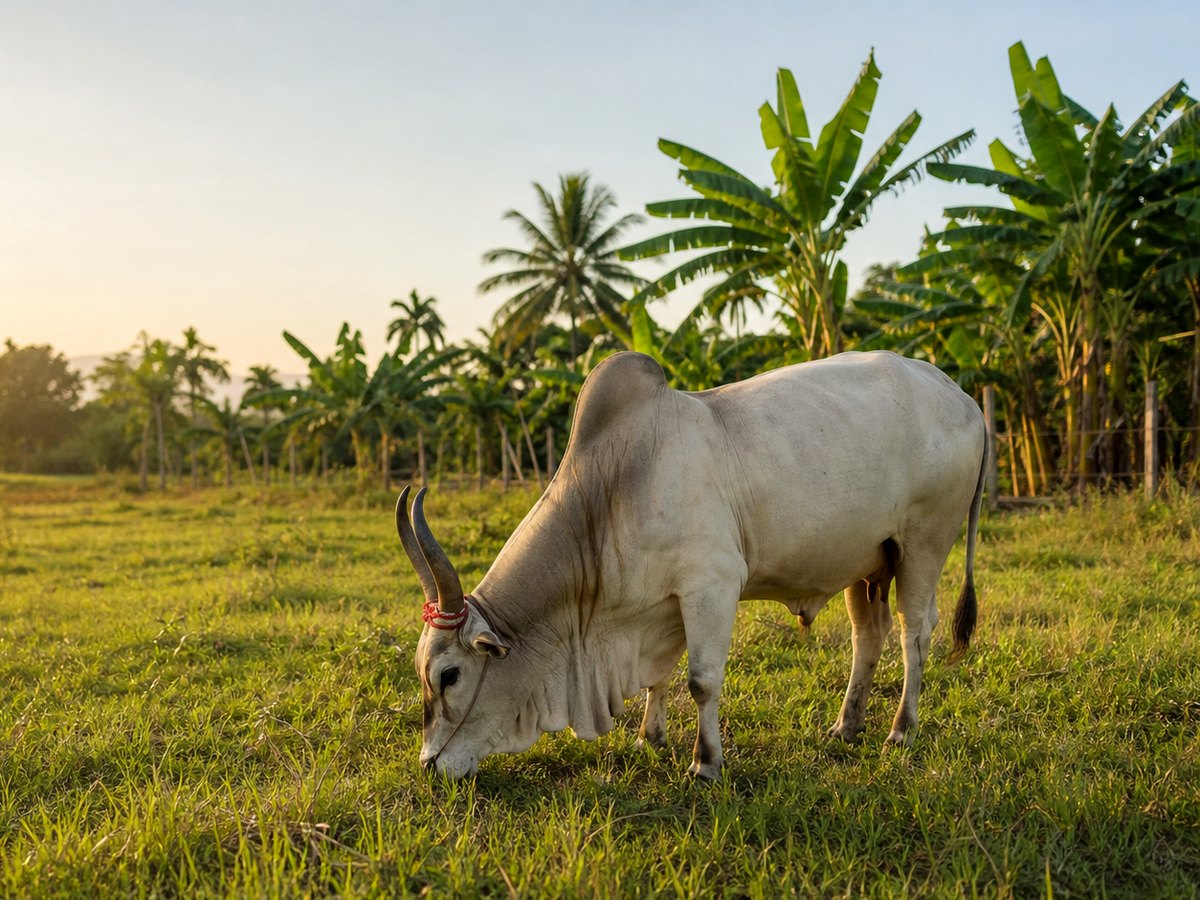
- Coat: Grey to white (cows); darker grey to near-black on hump and forequarters (bulls)
- Horns: Medium length, curving backward and slightly outward
- Build: Compact, muscular, well-proportioned. Prominent hump in bulls
- Weight: Bulls 400–500 kg; cows 300–350 kg
- Special trait: Exceptionally strong legs and hooves — built for hard ground
Milk Production
- Yield: 3–5 litres/day
- Fat content: 4.5–5.5%
- Protein: Pure A2 beta-casein
- Lactation period: ~270–300 days
For a deep dive into this breed’s ghee, read our dedicated Kangayam cow ghee guide.
Umbalachery: The Delta Breed of the Cauvery
Origin & History
The Umbalachery (also known as Jathi Madu or Southern Tanjore) is native to the Cauvery River delta — the rice bowl of Tamil Nadu. Centred around Umbalachery village in Nagapattinam district, this breed evolved specifically for wet-land paddy cultivation.
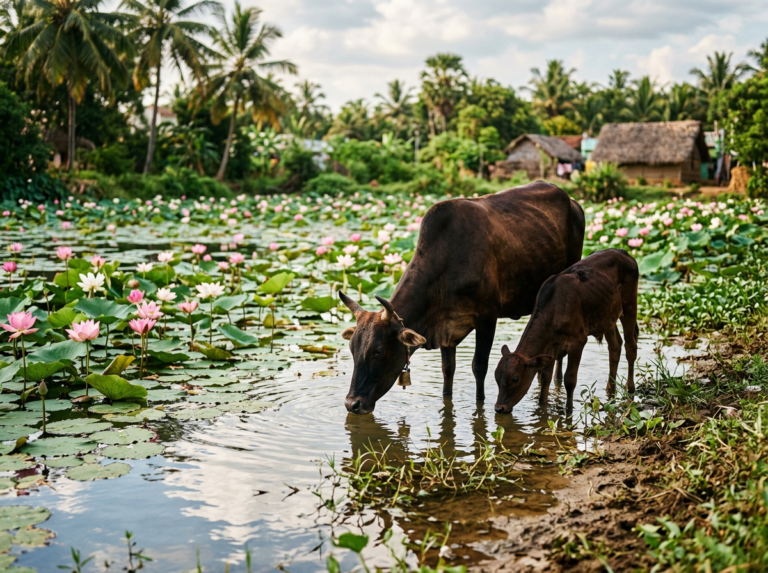
For centuries, Umbalachery cattle were indispensable for ploughing waterlogged rice fields — work that required animals comfortable standing in knee-deep water and mud. Their wide, splayed hooves and calm temperament made them uniquely suited for this role.
Physical Characteristics
- Coat: Reddish-brown to dark brown — one of the few naturally coloured (non-grey) native breeds in Tamil Nadu
- Horns: Short, curving forward and inward — distinctive and compact
- Build: Medium-sized, sturdy. Lower to the ground than Kangayam
- Weight: Bulls 300–400 kg; cows 200–300 kg
- Special trait: Wide, flat hooves — adapted for walking in soft, waterlogged paddy soil
Milk Production
- Yield: 2–4 litres/day
- Fat content: 4.0–5.0%
- Protein: Pure A2 beta-casein
- Lactation period: ~240–280 days
Unique Value
Umbalachery milk, while lower in volume than Kangayam, has a distinctive richness attributed to the breed’s diet of rice straw, paddy husks, and delta-region forage. The ghee from Umbalachery milk has a subtly different flavour profile — slightly sweeter, with a lighter golden colour.
Sustainable farming with indigenous TN breeds
Pulikulam: The Jallikattu Warrior of Southern Tamil Nadu
Origin & History
The Pulikulam breed (also called Palingu Madu or Kilan Madu) is native to the Sivaganga and Ramanathapuram districts of southern Tamil Nadu. Named after the Pulikulam village near Sivaganga, this breed is most famous for its association with Jallikattu — Tamil Nadu’s ancient bull-taming tradition.
Pulikulam cattle were traditionally grazed on scrublands and maintained by pastoral communities (Konars/Idaiyars). The breed developed in the harshest conditions — scorching summers, sparse vegetation, minimal water — producing incredibly hardy animals.
Physical Characteristics
- Coat: White to light grey body with distinctive dark (black/brown) markings on the face, ears, and feet
- Horns: Long, sweeping upward and outward — the most dramatic horns among TN breeds
- Build: Lean, athletic, agile. Built for speed rather than bulk
- Weight: Bulls 350–450 kg; cows 250–300 kg
- Special trait: Speed and agility — Pulikulam bulls are prized in Jallikattu for their explosive energy
Milk Production
- Yield: 1.5–3 litres/day
- Fat content: 4.5–5.5%
- Protein: Pure A2 beta-casein
- Lactation period: ~220–260 days
Unique Value
Pulikulam cows give the least milk of the four TN breeds, but it’s exceptionally concentrated. The breed’s survival on sparse, dry-land forage means the animals extract maximum nutrition from minimal feed — and that concentration shows in the milk. Pulikulam milk and ghee have a particularly intense flavour.
Bargur: The Hill Cattle of Erode
Origin & History
The Bargur breed is native to the Bargur Hills in Erode district — a forested, hilly region in the Western Ghats foothills. This is the rarest of Tamil Nadu’s Tamil Nadu native desi cows, with an estimated population of only 15,000–20,000 animals.
Bargur cattle are semi-wild in nature. They graze freely in the forested hills, returning to settlements only periodically. This free-ranging lifestyle, combined with the hills’ diverse vegetation, produces animals with unique characteristics.
Physical Characteristics
- Coat: Brown to reddish-brown — the most distinctively coloured TN breed
- Horns: Medium length, curving upward
- Build: Light, agile, and surefooted — adapted for hilly terrain
- Weight: Bulls 300–400 kg; cows 200–280 kg
- Special trait: Speed and endurance on rough terrain — historically used for cart racing in Erode region
Milk Production
- Yield: 1–3 litres/day
- Fat content: 4.5–6.0% (highest among TN breeds)
- Protein: Pure A2 beta-casein
- Lactation period: ~200–250 days
Unique Value
Bargur cattle graze on diverse forest vegetation — herbs, shrubs, leaves, and grasses that don’t exist in plains-based farming. This diverse diet is believed to contribute to the exceptional flavour and micronutrient profile of Bargur milk and ghee. The breed’s near-wild lifestyle also means zero use of hormones or antibiotics.
Bargur is the most endangered of TN’s Tamil Nadu native desi cow milk source and one of the hardest to source milk from commercially. When available, Bargur ghee commands the highest premium.
Tamil Nadu Native Cow Breeds: Comparison Table
- Kangayam: Region: Western TN | Milk: 3–5 L/day | Fat: 4.5–5.5% | Build: Muscular/compact | Conservation: At risk | Primary use: Draught + dairy
- Umbalachery: Region: Cauvery Delta | Milk: 2–4 L/day | Fat: 4.0–5.0% | Build: Medium/sturdy | Conservation: Vulnerable | Primary use: Wet-land paddy work
- Pulikulam: Region: Southern TN | Milk: 1.5–3 L/day | Fat: 4.5–5.5% | Build: Lean/athletic | Conservation: Declining | Primary use: Jallikattu + pastoral
- Bargur: Region: Bargur Hills, Erode | Milk: 1–3 L/day | Fat: 4.5–6.0% | Build: Light/agile | Conservation: Critical | Primary use: Hill grazing + cart racing
Tamil Nadu Breeds vs Gir & Sahiwal: Key Differences
When most people think of A2 ghee, they think of Gir (Gujarat) or Sahiwal (Punjab). Here’s how Tamil Nadu’s breeds differ:
Climate & Adaptation
- TN breeds: Evolved for South Indian semi-arid heat (40°C+ summers). Maximum heat tolerance.
- Gir: Adapted to Gujarat’s dry climate — also heat-tolerant but from a different ecological zone.
- Sahiwal: From Punjab’s irrigated plains — more temperate-adapted, less heat-hardy than TN breeds.
Milk Characteristics
- TN breeds: Lower volume (1–5 L/day) but higher fat % (4.5–6.0%). Ultra-concentrated.
- Gir: Moderate volume (6–12 L/day), moderate fat (4.0–5.0%). India’s most popular A2 dairy breed.
- Sahiwal: Higher volume (8–15 L/day), moderate fat (4.0–4.5%). Best A2 yield per cow.
Breeding History
- TN breeds: Primarily bred for draught power, with dairy as secondary. Less selected for milk volume.
- Gir/Sahiwal: Selectively bred for dairy production over centuries. Recognised by FAO as dual-purpose dairy breeds.
Market Presence
- TN breeds: Virtually unknown in the national A2 ghee market. Very few brands use them.
- Gir: Dominates the A2 ghee market — dozens of brands across India.
- Sahiwal: Well-represented in North Indian A2 dairy market.
The bottom line: Tamil Nadu breeds produce less milk but of arguably higher quality. They are under-represented in the A2 market, creating both a gap and an opportunity for consumers seeking something genuinely different.
A2 Milk Quality Across Tamil Nadu Breeds
All four Tamil Nadu breeds produce pure A2 beta-casein milk. This is a genetic certainty — these breeds have never been crossed with A1-producing European breeds at any significant scale.
What varies is the milk’s composition:
- Fat content: Bargur leads (up to 6%), followed by Kangayam and Pulikulam (5.5%), then Umbalachery (5%).
- SNF (Solids Not Fat): All breeds show high SNF (8.5–9.5%), indicating dense protein and mineral content.
- Flavour: Each breed’s diet and environment create subtle flavour differences in the milk and ghee.
When Raghas Dairy produces ghee from a mix of these Tamil Nadu native desi cow source, the result is a complex, multi-dimensional flavour that no single-breed ghee can replicate. It’s the terroir of Tamil Nadu cattle in a jar.
Learn more about the production process in our Bilona method guide.
Conservation Status & Why It Matters
All Tamil Nadu native desi cow heritage are declining in population. The causes are similar across breeds:
- Mechanisation: Tractors replaced draught cattle from the 1970s onward, removing the primary economic incentive to maintain native herds.
- Crossbreeding: Government dairy programmes promoted crossbreeding with HF and Jersey cattle for higher milk yields, diluting native native cow source.
- Urbanisation: Grazing lands converted to housing and industry, reducing space for cattle.
- Economics: Native cows producing 3–5 litres/day cannot compete with crossbreeds at 15–25 litres/day on a volume basis.
Current Efforts
- NBAGR Registration: All Tamil Nadu native desi cow source are registered, giving them formal recognition and protection status.
- Tamil Nadu Government: The Animal Husbandry Department runs breed conservation programmes, maintaining nucleus herds at government farms.
- Jallikattu movement: The 2017 pro-Jallikattu protests in Tamil Nadu brought massive attention to native breed preservation. The sport’s continuation provides economic and cultural incentive to maintain Pulikulam and Kangayam bulls.
- Private dairies: Companies like Raghas Dairy create economic value for native breed milk — giving farmers a reason to maintain native herds instead of switching to crossbreeds.
Every purchase of Tamil Nadu native breed ghee directly supports conservation. When farmers can sell native breed milk at a premium, they have an economic reason to keep these animals. This is market-driven conservation — arguably more sustainable than government subsidies alone.
Raghas Dairy & Tamil Nadu Native Breeds
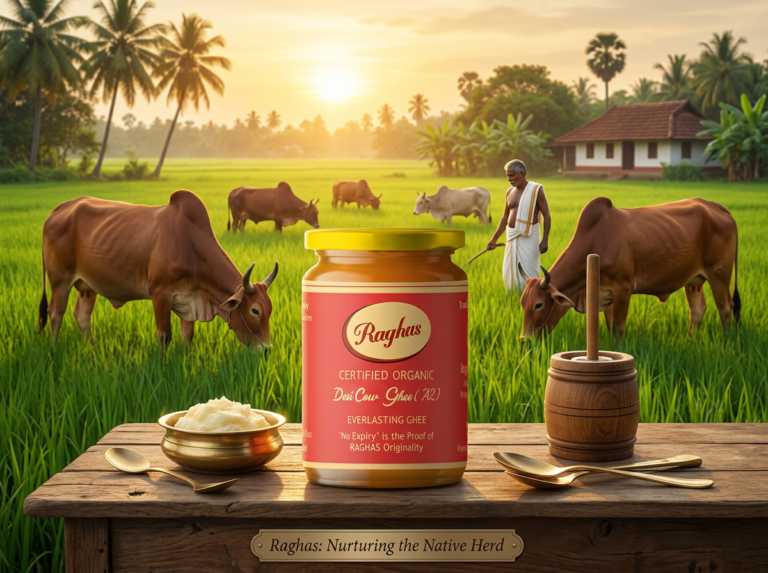
Raghas Dairy was founded in Madurai specifically to produce A2 ghee from Tamil Nadu’s own native breeds. Not Gir from Gujarat. Not Sahiwal from Punjab. Tamil Nadu breeds, for Tamil Nadu’s tradition.
Our approach:
- We raise all Tamil Nadu native desi cow source: Kangayam, Umbalachery, Pulikulam, and Bargur
- Our farm is in the Madurai region, where we raise our own herds
- We produce ghee via the traditional Bilona method — no cream separators, no shortcuts
- By raising native breeds ourselves, we directly ensure breed preservation and genetic purity
- We tell the breed story because we believe consumers should know what they’re buying
Read our ultimate guide to A2 ghee for the full picture of what makes our ghee different.
Key Takeaways
- Tamil Nadu has four native cattle breeds: Kangayam, Umbalachery, Pulikulam, and Bargur — all producing pure A2 milk.
- These breeds evolved for South India’s climate and terrain, making them uniquely adapted and resilient.
- Their milk has higher fat content (4.5–6%) than most other native breeds, producing exceptionally rich ghee.
- All Tamil Nadu native desi cow source face population decline. Bargur is critically endangered.
- Buying A2 ghee from TN native breeds directly supports conservation through market economics.
- Raghas Dairy is one of the few brands working exclusively with a mixed Tamil Nadu native desi cow herd.
Frequently Asked Questions
How many native cow breeds does Tamil Nadu have?
Tamil Nadu has four recognised native cattle breeds: Kangayam, Umbalachery, Pulikulam, and Bargur. All four are registered with the National Bureau of Animal Genetic Resources (NBAGR) and produce pure A2 beta-casein milk.
Do Tamil Nadu native cows produce A2 milk?
Yes. All Tamil Nadu native desi cow heritage — Kangayam, Umbalachery, Pulikulam, and Bargur — produce pure A2 beta-casein milk. They have not been crossbred with European dairy breeds, so their A2 native cow source remain intact.
Which Tamil Nadu cow breed gives the most milk?
Kangayam cows give the highest yield among TN native breeds at 3–5 litres per day. Umbalachery gives 2–4 litres, Pulikulam 1.5–3 litres, and Bargur 1–3 litres. These yields are lower than crossbreeds but the milk is significantly richer in fat and nutrients.
Are Tamil Nadu native cow breeds endangered?
Yes, all Tamil Nadu native desi cow source face population decline. Bargur is the most critically endangered with an estimated population of only 15,000–20,000. Pulikulam has also declined sharply. Kangayam and Umbalachery have better numbers but are still far below historical levels. Conservation efforts by the Tamil Nadu government and private breeders are ongoing.
How are Tamil Nadu native breeds different from Gir and Sahiwal?
Tamil Nadu breeds evolved in South India’s hot, semi-arid climate. They are typically smaller, hardier, and more heat-adapted than Gir (Gujarat) or Sahiwal (Punjab). TN breeds were primarily developed as draught animals with dairy as a secondary trait, while Gir and Sahiwal are recognised dairy breeds. All produce A2 milk, but TN breeds tend to have higher fat percentages with lower overall volume.
About the Author: This article is written by the Raghas Dairy Team from Madurai, Tamil Nadu. We produce A2 Desi Cow Ghee from a mixed Tamil Nadu native desi cow herd — Kangayam, Umbalachery, Pulikulam, and Bargur — using the traditional Bilona method. Preserving these breeds through economic value creation is central to our mission.
Shop Raghas A2 Desi Cow Ghee — Free Shipping Above ₹1,750 →
Frequently Asked Questions
What is A2 milk and why is it better?
A2 milk comes from cows that naturally produce only A2 beta-casein protein, which is easier to digest and may cause fewer digestive issues compared to A1 milk from hybrid cows.
How is fresh A2 milk different from regular milk?
Fresh A2 milk is minimally processed and comes from indigenous cows, retaining more natural nutrients, enzymes, and beneficial properties compared to heavily processed regular milk.
Is A2 milk safe for lactose intolerant people?
While A2 milk may be easier to digest than A1 milk, it still contains lactose. People with lactose intolerance should consult their healthcare provider before consuming any dairy products.